Showing posts with label North African Meals. Show all posts

Tuesday, 3 February 2015

Meal 51. Tunisian Bricka, Slata Mechouia and Tagine

The lovely Sonia has volunteered to be the first to help revive my 80 meals project (stuck at 50 meals since 2008!) while we are both in Sierra Leone. She is French-Tunisian and speaks Arabic, French and English. Her work brought her to Sierra Leone, but she has also spent time in Angola and Senegal in recent years. About her short visits in Dakar she says "it is like Petit Paris!" Not many would say Freetown is like a Little Paris, or a Little London for that matter.

We discussed my old blog project over drinks and she seemed willing to help out, but I was still surprised to receive a text a few days later that read: "As promised last Friday, tonight dinner at my place to enjoy Tunisian food." So excited!

When we arrive, the table is beautifully set in the living room and Sonia is putting the finishing touches on the meal in the kitchen, placing olives and hard boiled eggs on the slata mechouia, a spicy vegetable salad made with tomato, bell pepper, onions, chillies and a generous helping of tuna. Apparently Tunisia is famous for its delicious tuna, both fresh and in cans. However, despite their similarity, the country and the fish are not linguistically linked. The slata is served with flatbread, easy to get in Sierra Leone due to the large Lebanese community here.

Tuna makes another appearance, again with egg, as the filling of the bricka, crunchy triangular parcels of filo pastry. Very tasty!

As we dig in to the slata, bricka and tagine (a kind of omelet) with saffron rice, Sonia amuses us with stories of a hallucinogenic fish common in her town. It is called chelba in Arabic or la saupe in French and it is renowned for being good to eat as well as for its ability to make people go crazy. They say it is better to eat it at lunch, because if you wait till dinner, tempers can fray and the meal can end up causing a divorce! Sonia tells us her sister once had visions of the devil descending upon her after eating this notorious fish.

I initially do not really believe it, never having heard of any animals having mind-altering properties, apart from psychoactive toads. But then Sonia whips out her tablet and shows me the wikipedia page describing it...hard evidence! It seems it is a toxin in the green algae these fish like to eat that causes them to induce these bizarre hallucinations.

After the main meal is over we have some coffee and cheesecake (not very Tunisian!) and Sonia's Lebanese friend promises he will make some traditional dishes soon for the next entry. In addition, a few days later, Sonia herself invites around 20 people over for couscous, a truly traditional North African dish. There are mountains of couscous on huge platters, as well as exquisitely tender mutton, chickpeas with raisins, and pumpkin/potatoes/onions to accompany the twice steamed grains. Remarkably similar to the Moroccan and Sahrawi dishes I had so many years ago...


Monday, 2 February 2015

Meal 43. Sahrawi Couscous


This meal is the most "political" meal I have had during the whole project. The nationality "Sahrawi" probably won't ring a bell for most people. It is the term used by/for refugees from the Western Sahara territory. This is a huge chunk of Morocco; on some maps it will have a different color. After Spain left Morocco in 1975, control of the Western Sahara has been disputed by Mauritania, the Moroccan government and Frente Polisario, who want independence for the region.

And it is the representative for Polisario in the Netherlands, Ali, who will be making couscous for me tonight. I was introduced to him by a friend of mine, who got a visa from him to visit the Sahrawi refugee camps in Algeria. It is very interesting to meet someone whose life has been influenced so strongly by the politics of his home country. He had just been studying medicine in Spain for three years when he was called back in the mid seventies to help his country fight the Moroccan rule. He mostly served by running the Red Cross and remembers the period as very difficult. There was a lot of fighting then, guerilla warfare with a lot of people getting hurt or killed. Polisario formed a kind of government in exile of the Sahrawi refugee population in Algeria. Ali was their minister of education for a while and tells me about many young Sahrawi being educated in Cuba. Mostly as doctors and as teachers. They shared the language and the common past as Spanish colonies.
Ali has had many different "nationalities", as the Sahrawi passport is only recognized in certain countries and he has to be able to travel freely to represent Polisario. At the moment, he is officially Spanish.

During the preparations for the meal, we speak about the past and present of his country and I am impressed by his gentle spirit. His attitude seems to be a mix of sadness, frustration, determination and hope. The fight for independence has been going on for so long now, more than 30 years. And though there has been a ceasefire and talk of a referendum since 1991, no real steps forward have been taken. It is virtually impossible for a Sahrawi to travel from the camps in Algeria to his birthplace because of the wall that has been built by the Moroccan government.

In essence, the couscous Ali is preparing is not that different from the Moroccan couscous I had earlier (see Meal 12. ). Again, the couscous is steamed twice, with a lot of attention to the "fluffing" in between, as seen at right. It is served with succulent lamb, chick peas and a multitude of vegetables. Squash, carrots, cabbage, bell peppers, tomatoes and nabos, turnips. Ali tells me that though this is a typical dish, a more unique meal is eaten in the Sahara desert. When groups of men head out into the desert for whatever reason, they will take flour, onions and meat with them. The flour is made into unleavened bread with the sand as an oven. This is served with a sauce of meat and onions on top. For the authentic experience I think I would have to travel with them into the desert! Who knows if this might happen one day, and who knows what the situation of the Western Sahara will be then...

(The original post about this meal is from May 11, 2007)

Sunday, 1 February 2015

Meal 12. Moroccan Couscous


Couscous is the first thing that comes to mind when Moroccan cooking is mentioned. That's why Fatiha decided to make it as a "typical Moroccan meal". But it turns out she doesn't even like couscous herself! She makes it three or four times a year, only when there are guests. Her own favorite meal is based on potatoes, so it seems she has adapted well to Dutch society (see Meal 1. Dutch andijviestamppot). We actually met as "integration buddies" about two years ago, a scheme organized by the Utrecht municipality. I was supposed to introduce her to Dutch society, I guess. But usually we just ended up drinking tea and chatting. The six months I had to integrate Fatiha have long since passed, but we still enjoy each other's company.
When I arrive, she tells me she had almost cancelled our date. Why? Some wire had short-circuited and there was no electricity on the ground floor of her house. And the guy who came to fix it was four hours late! So most of the day she had been walking around with candles.
Also, her oven is electric; so there will be no Moroccan cookies to go with the mint tea tonight...
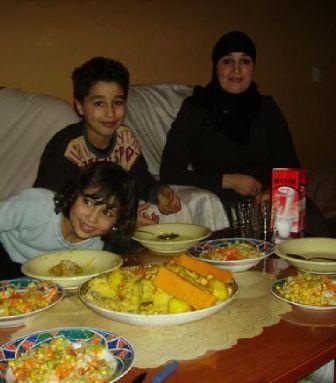
The couscous is prepared the traditional way. This entails steaming it twice, with butter or oil added. In the photo you can see the special couscous pan, behind the pan with pumpkin. The whole dish consists of plenty of couscous, potatoes, pumpkin, carrot, tomato, onions, chickpeas, chicken wings and cilantro to taste.
Adding potatoes is actually not that common in Morocco, but Fatiha's mother did it as well, so we can call this a "traditional" dish...
Above right you can see Fatiha's youngest daughter, Miryam, posing next to the finished platter of couscous. Will she be preparing the same meal in 10 years time? Quite possibly, though at the moment her main concerns are playing with her baby brother and jumping off the couch in creative ways. Fatiha is planning on letting her follow gymnastics classes to focus her energy. This might mean cartwheels and handstands in the living room in the future! Osama, Miryam's 9-year-old brother, has already taken to playing soccer inside. He's a big fan of Ibrahim Afellay, a very succesful Dutch/Moroccan soccer player for PSV. After dinner, there's an interview with this 19-year-old wonder boy on TV. I'm mostly impressed with the amount of gel he manages to put into his curls, but also by how far he has come for a boy his age.
Osama tells me Ibrahim lives right around the corner from his aunt, here in Utrecht. A local role model.
Fatiha's husband, Azzedine, is working late tonight; he's a bus driver. And a good cook as well. A few months ago he made a great meal for us with fried fish, shrimp and mussels. But according to Fatiha, there is one problem with having him be the cook: he doesn't clean up the kitchen afterwards! I have to say; my mother complains about my dad doing exactly the same thing...
After dinner, we have some fruit. Fatiha has bought 3 kilos of oranges, because her youngest son, Adam, really likes the taste of them. But the whole family will be going to Germany in a few days to visit Fatiha's parents, so they won't be able to finish all of it. She gives me some fruit to take home with me; a touching gesture she has made in the past as well. As if she wants to ensure that I will still get enough vitamins living my "student lifestyle"...

(The original post about this meal is from March 09, 2006 and if you can read Dutch, a local newspaper published an article about the blog and this particular meal, see below. Fatiha said afterwards acquaintances who read it approached her and said:"How come you don't like couscous?!")