Sunday, 22 March 2015

Meal 53. Sierra Leonean Cassava Leaf Plassas, Fried Plantain and Banana Akara

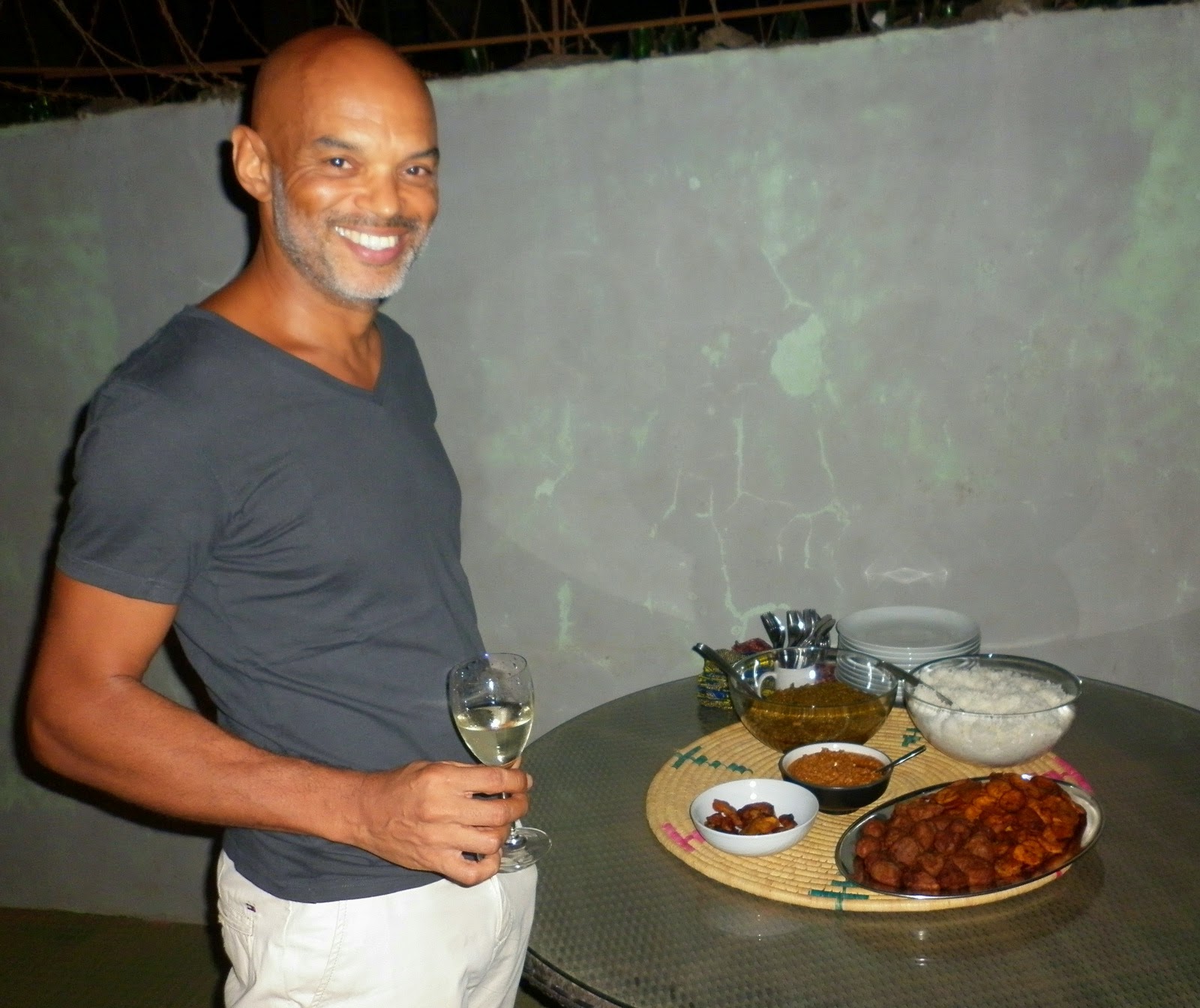
Sheka dishing out the prepared food
The host for this meal is my friend Sheka, who is half Sierra Leonean, half Scottish and a bit of a ‘global soul’, having lived all over the place, from Iran, Thailand and Zambia to Denmark and the UK. He has been present as a guest at the two previous meals (Tunisian and Lebanese) and could not let me leave the country without a local entry for the blog. His mum, Yabome, has been chartered to do the cooking and I arrive at Sheka’s house expecting to find her adding the finishing touches to the meal in the kitchen. But no, she has left already. All the food is there, neatly delivered in Tupperware, ready for Sheka to dish out to a small group of invitees…he laughingly explains that this type of delegating is very typical, “part of the culture” and that Yabome herself probably also had help with the preparation.


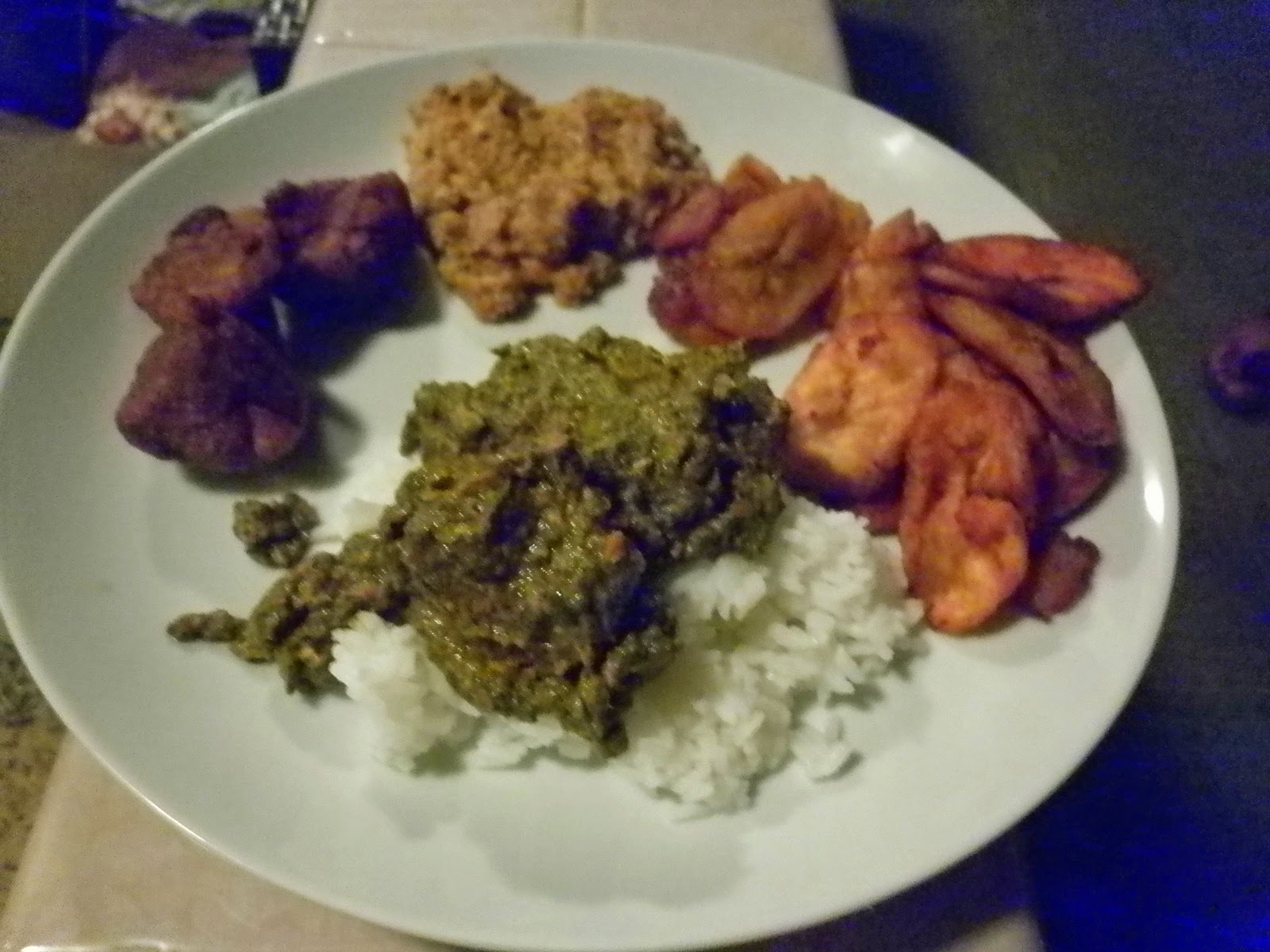
The meal served is quintessentially Sierra Leonean as the local staple is rice with a stew, called plassas (the word is apparently a contraction of 'palaver sauce'). At my work, we eat a rotation of plassas: groundnut, cassava leaf, potato leaf or bean stew with white rice. I am curious to see if Yabome’s cassava leaf plassas is superior. Indeed it is, filled with big chunks of succulent beef. The side dishes are also very typical; fried plantain and banana akara (a kind of fritter made with rice flour) served with fish sauce. The combination of fishy and sweet is not very common in Western cooking, but it works very well.


Charmingly presented on an authentic 'shuku blay' mat
The stew we are eating tonight was Sheka’s favourite while growing up, but now he prefers potato leaf, routinely asking for that to be prepared the first day he is back in the country. When he (occasionally) does cook Sierra Leonean food himself while entertaining British friends, he normally opts for groundnut stew, as even novices to African cuisine enjoy that. Though a lot of the dishes mentioned are common in other parts of West Africa, he says Sierra Leoneans are comparatively “big on pepper”, they like their stews to be quite spicy. As well, the rice that accompanies the stew is so important that most people feel you have not truly eaten if you have not had any rice. This is also the case in Indonesia, where my mother’s family is from. I tell Sheka that my grandmother taught me to eat rice only with a spoon, and we have a laugh at our shared disdain of people who prefer a fork. Though a lot of Sierra Leoneans eat with their hands (this is called mondo), many travel with their own spoon. In Sheka’s household almost everybody has their personal spoon too.


Rice with cassava leaf. In back: akara, fish sauce, plantain
Potato and cassava leaf are often consumed, in plassas, but most people do not eat many other vegetables. Lettuce, cucumber, tomatoes, carrots etc. are all produced locally and for sale at roadside stands. However, they are seen as food for rich people. Sheka tells me one day an aggrieved lady came to his mother’s house, and at one point shouted at her: “Isn’t it true that you eat salad?!” This can be translated as “Admit you are a middle class and westernized, not a real Sierra Leonean like me!”


Related to this lack of love for vegetables is the confusingly named ‘African salad’ found on the menu of some local restaurants. Newly arrived visitors might order this and be unpleasantly surprised when a dish arrives that consists of tinned sardines, luncheon meat (Spam), baked beans and mayonnaise. Not really a salad, and not all that African!

Monday, 9 February 2015

Meal 52. Lebanese Sawda, Malta, Fatteh and Tabbouleh

Sahid is my generous host this evening, and as I walk onto the balcony, he asks: "What is your poison?" I opt for arak, the only Lebanese drink on offer. It is very much like pastis, but all the other guests at the dinner tut at my glass and warn me about drinking it. It is apparently so strong that you will need a bottle of water by your bed, and you can only drink it with food (mezze) or you will be knocked out cold. Heeding their advice, I sip slowly and carefully; it is delicious...and no ill effects are noted.

Sahid is incredibly hospitable and tells me that every Sunday he hosts a big fish dinner after his weekly angling trip off the coast of the Western Area Peninsula. He is one of the roughly 30,000 Sierra Leoneans of Lebanese descent (these estimates vary wildly depending on the source). The Lebanese diaspora is huge, with 'Lebanese' outside the country vastly outnumbering the ones in Lebanon. In Sierra Leone, they first arrived in 1893. Sahid's grandfather was one of the first to land and soon married a local Madingo woman. So Sahid is a bit Madingo, as well as 2nd and 3rd generation Lebanese. A portrait of his father has pride of place in the living room, an imposing figure in a flowing white gown.
Sawda, chopped raw liver

Tonight's gathering is an international affair, with Sierra Leonean, British, Irish, Lithuanian and Belarusian guests as well as varied Lebanese. Sahid and a few of the invitees tell me they feel most 'at home' with Lebanese Sierra Leoneans or Lebanese Londoners, more so than when they are in Lebanon. Sahid first set foot in Lebanon when he was 22 and confides he had to study hard to truly master written and spoken Arabic. Some part of the evening is spent discussing how crazy expensive Beirut is, how people in clubs easily drop $15,000 on a bottle of champagne or a private table and how people are quite 'money conscious' there.

The fact that there are both Christian and Muslim Lebanese does not seem to phase this gathering, who say it

Sahid showing me how to eat the liver
is all the same to them. Most have spent many years in Sierra Leone, as well as in Lebanon, the UK, Dubai, or the Netherlands. These friends tease Sahid mercilessly about him 'slaving away in the kitchen all day' to prepare everything for this dinner, and he sheepishly laughs and shrugs. I suggest his role was more of a co-ordinating and delegating host, and he smiles that this might be an appropriate description. I recognize the malta (raw beef pâté, delicious) as
remarkably similar to one his neighbour Hoda made the week before...and just as tasty! Raw meat features in three separate dishes; the malta, the spicy beef tartare and the chopped raw liver (sawda). I had been forewarned about the liver, and had promised to at least try it. Scooped up with small pieces of Lebanese flat bread, with loads of fresh mint and raw onions, it is better than I expected. The beef tartare and the malta are great, and new to me. The refreshing salads (tabbouleh and fattoush) are familiar and offer a lighter touch. I try taking a little bit of everything, including some top quality hummus and my favourite of the evening: fatteh. This dish consists of chicken, yoghurt, chickpeas, fried bread, almonds and garlic.
Fatteh, on a traditional Sierra Leonean mat
I will definitely try to get repeats of this dish somehow soon, either at friends or a restaurant. There are many
restaurants in Freetown that feature Lebanese cuisine, but I do not recall having seen fatteh on the menu before, or chopped liver.

As I hear Sahid's friends joke around in a mix of Arabic and English, I ask if they call this Aranglish. They tell me the term they use is tabbouleh, not just the name of the mixed salad, but also of the amalgam of languages.

Tuesday, 3 February 2015

Meal 51. Tunisian Bricka, Slata Mechouia and Tagine

The lovely Sonia has volunteered to be the first to help revive my 80 meals project (stuck at 50 meals since 2008!) while we are both in Sierra Leone. She is French-Tunisian and speaks Arabic, French and English. Her work brought her to Sierra Leone, but she has also spent time in Angola and Senegal in recent years. About her short visits in Dakar she says "it is like Petit Paris!" Not many would say Freetown is like a Little Paris, or a Little London for that matter.

We discussed my old blog project over drinks and she seemed willing to help out, but I was still surprised to receive a text a few days later that read: "As promised last Friday, tonight dinner at my place to enjoy Tunisian food." So excited!

When we arrive, the table is beautifully set in the living room and Sonia is putting the finishing touches on the meal in the kitchen, placing olives and hard boiled eggs on the slata mechouia, a spicy vegetable salad made with tomato, bell pepper, onions, chillies and a generous helping of tuna. Apparently Tunisia is famous for its delicious tuna, both fresh and in cans. However, despite their similarity, the country and the fish are not linguistically linked. The slata is served with flatbread, easy to get in Sierra Leone due to the large Lebanese community here.

Tuna makes another appearance, again with egg, as the filling of the bricka, crunchy triangular parcels of filo pastry. Very tasty!

As we dig in to the slata, bricka and tagine (a kind of omelet) with saffron rice, Sonia amuses us with stories of a hallucinogenic fish common in her town. It is called chelba in Arabic or la saupe in French and it is renowned for being good to eat as well as for its ability to make people go crazy. They say it is better to eat it at lunch, because if you wait till dinner, tempers can fray and the meal can end up causing a divorce! Sonia tells us her sister once had visions of the devil descending upon her after eating this notorious fish.

I initially do not really believe it, never having heard of any animals having mind-altering properties, apart from psychoactive toads. But then Sonia whips out her tablet and shows me the wikipedia page describing it...hard evidence! It seems it is a toxin in the green algae these fish like to eat that causes them to induce these bizarre hallucinations.

After the main meal is over we have some coffee and cheesecake (not very Tunisian!) and Sonia's Lebanese friend promises he will make some traditional dishes soon for the next entry. In addition, a few days later, Sonia herself invites around 20 people over for couscous, a truly traditional North African dish. There are mountains of couscous on huge platters, as well as exquisitely tender mutton, chickpeas with raisins, and pumpkin/potatoes/onions to accompany the twice steamed grains. Remarkably similar to the Moroccan and Sahrawi dishes I had so many years ago...


Monday, 2 February 2015

Meal 50. Chinese-Singaporean feast

Though Derek (or Des) is originally from Singapore, he's lived in Australia since he was 9, and now in Oxford for a year or so. To my untrained ears, he sounds like somebody speaking 'posh', but with a bit of an Australian accent thrown in.
He loves to eat and to cook, and tonight is my lucky night: time for a feast. We've spent many a happy moment in preparation discussing Singaporean cuisine and its similarities to Chinese and Indonesian/Malay cooking (with which I am more familiar).
Though it is 'only' a city state, Singapore has almost 5 million inhabitants and is one of the most densely populated nations on earth. Before meeting Des, I had already read a very enthusiastic article about the world famous 'hawker centres' which seem to bring together specialists of various dishes in hygienic-but-authentic outdoor or indoor conglomerations of foodstalls. Some people seem to visit Singapore only for the food! Sadly, I've only been airport for a stopover...

In preparation, Derek has bought bagloads of ingredients at the local Chinese store in Oxford...this is a great shop that I enjoy wandering around in a mildly perplexed state. One day I came home with paper money that had "Bank of Hell" printed on it...so called Hell Money, used to provide dead ancestors with cash for the afterlife. I also saw a guy in front of me in the queue with a 2 kg bag of frozen chicken feet, hard to get at the local Sainsbury's. Derek shows me some packages that say "Dried Provisions" on them as the only indication of what can be found inside (for those who cannot read Chinese script). Luckily he is a man with a plan and gets to preparing the feast for me and his flatmate. All I need to do is watch and chop the occasional vegetable.

To start, I am served bak kut teh soup with bean sprouts, mince-meat and salted vegetables. These were served with steamed char siu buns (pictured at left). This is the only part of the meal that I have easily recreated at home...as all it involves is buying the frozen buns and steaming them above hot water for ten minutes. I love the sweet and savoury taste of the pork filling.

The main course consists of an authentic dish of stir-fried kailan and cloud-ear fungus with baby corn and oyster sauce. Kailan is otherwise known as 'Chinese broccoli' or 'Chinese kale'. I would say it's more like kale than broccoli, see right. The cloud-ear fungus was one of the 'Dried Provisions'. When fresh...they supposedly resemble human ears. Not sure where the clouds come in.

The final savoury dish is prawn laksa noodles served with fried onions and hard-boiled eggs.
I am absolutely stuffed and need to give everything some time to digest before having any space for desert. Desert is more of a 'fusion' dish, lovely vanilla ice cream with lychee and raspberries.
You can understand why this meal deserves the epithet 'feast' as with so many dishes, it is difficult to chose the one most representative for the whole meal. I think I'll need to travel to Singapore sometime in the near future and venture outside of the airport, but in the meantime hope to entice Derek to teach me more about this cuisine (=cook for me) while we're both still in Oxford.

(The original post about this meal is from December 21, 2008)

Meal 49. Polish Żurek, Bigos and Gołąbki

When I arrive at this cosy house in North Oxford for the Polish meal, it turns out the blog was checked out beforehand and lots of photos were made of all the preparations to help me out. This allows me to relax and just chat to Jolanta about what Polish cuisine is like. She warns me:"It is delicious, but it is possibly the most difficult food in the world to digest!"
Possibly this is due to the large role cabbage plays in Polish dishes.
Our starter, the white soup żurek (see picture), does not contain this vital ingredient. The main course, though, consists of stuffed cabbage (gołąbki) and bigos, which takes two days to prepare and has both normal and sour cabbage in it. It should normally be drunk with cold vodka!

The stuffed cabbage rolls are called 'pigeons' (due to a somewhat similar shape?) and have a lovely mince and rice filling. In the photo above you can see Yolanta preparing them. They are youngest daughter Zuzanna's favourite and she manages to finish at least four of them. Looking at her slim figure, I must assume that they aren't prepared that often!

Contrary to my prejudiced expectations, Darek (at right) actually did most of the cooking. He and Jolanta met when they were 16 and 13 and by now they've been married 18 years! Their cosy household is a warm haven for the (often single) young Poles who end up in Oxford for work or study.
Though they love everything about Poland (except the politicians), the economic insecurity meant that their move to the UK took away a lot of stress. As Jolanta succinctly puts it:"I no longer have to choose between buying food and paying the rent."
I am very impressed by how fluently she speaks English after so few years here. She said she thought she spoke it while still in Poland, but could not understand a word people said in the UK when she just arrived. Incredibly, she is now well on her way to being an accredited interpreter.
Though at the moment she is still the senior ward housekeeper at the stroke unit in Oxford's major hospital: "Learning to follow what the stroke patients are trying to say is a bit like learning a new language; it is satisfying that I can understand them almost all the time by now."

The dessert after this lovely dinner is a spice cake prepared by Ewelina (at left) who helped me contact the family initially. Another of Zuzanna's favourites (see below)!

We discuss how we would actually need a "Polish meal part 2" to include classic dishes as pierogi, borsht and cheesecake.

I'm up for it, and can confide that I had no digestive problems after this first copious meal...

Here is the recipe Jolanta emailed me to recreate the bigos at home. Be aware that it tastes best if prepared a few days in advance!

(The original post about this meal is from September 26, 2008)

Meal 48. Greek Cypriot Makaroniatou Fournou and Ttavas


Maria, a social psychologist, has gone to great lengths to provide an authentic Greek Cypriot meal. The email with recipes solicited from her mother and grandmother is stuck to the fridge. For expert advice on the desert, galactoboureko, a visit was arranged to a local Cypriot matriarch. Maria's compatriot, Yiannis (at right), is helping out - the local matriarch is his auntie. In total, seven people will be enjoying this feast tonight, including Pascalis, a Greek friend who can help separate the typically Greek Cypriot from the plain Greek dishes.

We start off with pita and haloumi, a lovely cheese that is probably Cyprus' most famous export. Maria tells me her grandma prepares this every morning as breakfast for her grandfather.
In general, most Cypriots prefer to start the day with something a bit lighter, such as frappé.
Pascalis immediately informs us that this cold coffee beverage was invented at the International Trade Fair in Thessaloniki (in 1957). So now you know the origins of this famous frothy drink!
The main course consists of Makaroniatou Fournou (a pasta dish with bechamel sauce), and Ttavas, made with beef and tomatoes. Both are oven dishes and preferably cooked in an authentic mud oven in your back garden.
As we all dig in and enjoy the hearty fare accompanied by a feta salad, I try to find out more about Cyprus. For example, what drives the economy? "Tourism!", answers Maria, while
Pascalis laughs: "Money laundering!"
Cyprus has been through a lot...Maria's synopsis is that it was ruled by the Ottoman empire who sold it to the British Empire in the late 19th century. In 1960, Cyprus gained independence after a number of years of protest against the British rule.
The first president was an archbishop and remained in power for 17 years! For some reason, the second candidate was a psychiatrist... and since early 2008 the government is leftist.
But Cyprus is most well know for the division between Greek and Turkish territory. Maria has been to the Turkish part quite often, but Yiannis never has. He does feel it is part of 'his country'. Though the situation is far from ideal, it is relatively peaceful, with no fighting or terrorism, and according to Maria, many people are alright with the current status quo.
Besides the locals, Cyprus has seen an influx of British expats who enjoy the climate and the relatively cheap property.
As well, I am told there are now quite a few "Russian artists". This is a polite euphemism for prostitutes...so even a Polish hooker would be referred to as a "Russian artist"!
Similarly, the many domestic helpers are known as "Sri Lankans", though they might be from the Philippines, Malaysia, etc. Maria tells me it is now so common to have help from overseas, that her own mother, when spotted cleaning by the neighbour's help, was asked:"So...where are you from? Sri Lanka?"

We finish off the meal with the lovely Galactoboureko pudding and sweet Commandaria wine, brought over from Cyprus by Maria's parents during their last visit. You can see how much fondness she has for this wine at right.

Here is the recipe for Ttavas, the beef stew.

(The original post about this meal is from August 18, 2008)
Meal 47. Belarusian Draniki and Bliny


This meal is quite special to me, as it marks the continuation of the project in the UK. Inni is my first host in Oxford and is cooking for me at her student housing in the centre of town.
Impressively, she has gained a full scholarship, and is one of the few Belarusian students in the UK, though the country is quite big, with a population of around 10 million.
I have to admit my mind goes pretty blank when the country Belarus is mentioned, though it is really not that far away (bordering Poland and Lithuania). Strangely, Belarusian cities like Minsk and Brest seem a lot more familiar. I even had a friend planning to travel "between four Brests", as there are cities called Brest not only in Belarus, but in France, Germany and Macedonia as well.

The dinner starts with traditional fare that I do associate with the region: red cabbage salad (very easy to make) and potato pancakes called draniki. They are made with grated potatoes and onions and bound with some egg and flour. Very similar to the latkes my father often makes, though Inni uses a much finer grater. The desert, bliny, crêpe like pancakes, again reminds me of a dish my dad makes, called blintzes (see Meal 17. Jewish-American Borsht, Challah and Blintzes). This might just be because his family came from the Ukraine, near Belarus, with similar cuisine. Though Inni tells me the medium-sized town she grew up in, called Borisov, used to be predominantly Jewish. However, most of them left or were killed long before she was born.

Belarus has opened up considerably after the Soviet collapse, but is still pretty much a communist state. When prodded, Inni can come up with memories of how rare bananas were when she was younger. In her recollection, her mother came home one special day with a whole suitcase of bananas. Inni didn't really like them as they were too firm for her taste. By the time they had ripened and become softer, she discovered she loved them. But by then, they were almost finished and she had to wait a long time before she could eat them again!
This story is quite 'exotic' to me and seems typical for someone from a former Soviet state. In most other aspects, I have to say Inni is very much a product of the global village; speaking fluent English, well travelled within Europe and even planning a trip to Nepal.

I give her the names and email addresses of my Nepalese friends (see Meal 2.) and imagine a distant reunion of 80meals participants.


To make your own Belarusian meal, click here for recipes (that Inni diligently penned down for me, at right).

(The original post about this meal is from July 7, 2008)