Thursday, 5 August 2021

Meal 71. Filipino lumpia and chicken adobo

Stirring the veg for the lumpia
I had recently been seeing a lot of Filipino recipes featured online by one of my favourite YouTubers Beryl, who cooks around the world with recipes she gets from followers around the world...a bit like my blog! It sounded like a very varied cuisine, with some familiar elements I recognise from Indonesian, American and Spanish food. So I felt very lucky to be contacted by Jo, who has been living and studying in Berlin for a few years and was enthusiastic about the idea of this blog. She is also a social entrepeneur and an artist who has set up up an NGO called SendToGive, inspired by the Filipino value of bayanihan (community spirit).

She greets me with a beautiful smile and has the ingredients for the starter prepped so I am able to see how they are prepared. For the main meal, chicken adobo, the chicken legs needed to be marinated in advance (in a mix of soy sauce, vinegar, sugar, garlic, bay leaves and black pepper kernels). So I can just enjoy the smell as this is bubbling away on the stove. Jo confides that she did ask for backup guidance from back home, to get inside tips about preparation.

Folded lumpias before frying
For the starter, we are having spring rolls, called lumpias. I recognise the name as in my childhood in Holland it was easy to find Vietnamese spring rolls for sale in food trucks selling lumpias (spelled loempias). I had no idea they were also popular in the Philippines - apparently also influenced by Chinese dishes and ingredients! However, it was tricky to find the proper lumpia ricepaper in Berlin. The one we used looked alright. After wetting down the paper to get it to soften, we filled it with the finely chopped vegetables, and folded it into rolls. They looked perfect frying in hot oil, but somehow decided to fuse with the paper towel (meant to soak up excess oil) on the plate...once removed, still very delicious. Served with a bit of homemade sweet-sour dipping sauce.
Frying up the lumpias

We chat about how one of the most important generators of income for the Philippines are their overseas workers (OFWs), who sent home $33B in 2020 alone. It helps that most Filipinos speak good English...as more than half of the OFWs are based in the US. Compared to some other countries who have a lot of overseas workers, it is more regulated in the Philippines, with training beforehand, and more efforts to make sure the OFWs are not abused and can return home if they need to. The first OFWs could be seen to be Filipino sailors on boats to Mexico in the 1500s. Jo does tell me about a more recent related development, where foreign companies employ Filipino workers in the Philippines (called BPOs, or Business Process Outsourcing), of which call centers would be the most familiar example.

The chicken adobo is served with rice and is tender and packed with flavour. At one point it becomes clear that Jo's father has a special love for poultry...but not to eat! He proudly breeds and keeps hundreds of beautiful fighting cocks, which participate in cockfighting (sabong) matches, a very popular spectator sport locally, maybe only second to basketball! Karaoke is also very popular, and Jo definitely enjoyed partaking with friends and at home...many families will have their own karaoke set.

Many of the most famous international celebrities with Filipino heritage are singers (Bruno Mars, Nicole Scherzinger, apl.de.ap from the Black Eyed Peas), though boxer Manny Pacquaio is maybe the best known Filipino national (who also likes singing and has even released a few albums!).

The crispy fried lumpias on the fateful paper towel

I would definitely like to try more of the Filipino dishes the country is known for (like pancit noodles), and after Jo tells me about travel options and shows me a few videos of jumping into a crystal clear blue ocean, I think the best way would be to actually travel to the country once corona subsides...in the meantime, I will visit one of the Filipino restaurants in Berlin!

Chicken adobo in foreground, lumpias in background


Wednesday, 7 July 2021

Meal 70. Kosovar fli

Kaltrina mixing the batter

 Kaltrina (also called Tina by friends and family) has chosen the most uniquely Kosovar dish to prepare for me tonight. She explains that a lot of the food eaten in Kosovo is somewhat similar to that in the surrounding countries (former Yugoslav countries like Serbia, Montenegro, Northern Macedonia as well as Albania). Turkish and Greek influences are evident as well, in this particular meal by the use of Greek yoghurt and feta cheese. Though the ingredients of fli (or flia/flija) are not that exceptional (flour, salt, oil and the aforementioned yoghurt) the preparation is like nothing I have ever seen before. It is also quite labour intensive, so Kaltrina pulls up two chairs so we can sit and chat in the kitchen right next to the stove and countertop. She gives me a quick overview of her life history in impressively idiomatic American English, especially considering she has never visited the US! Apparently, Kaltrina just has a knack for picking up accents easily. Her first language is Kosovar Albanian. She explains this is only a tiny bit different in accent and certain words and expressions to the Albanian spoken in Albania (comparable to British versus American English). Then, she also speaks English, German, Spanish, Turkish, and a bit of Polish. 

Kosovo declared its independence in 2008, and the Albanian language is a big part of the national identity. Kaltrina is proud to be from Kosovo, though at the same time she and her husband have realised that their ambitions (careerwise) are more easily realised abroad. After finishing their studies in Pristina, and a whole lot of paperwork later, they have managed to get work permits for Poland, Malta, and now Germany. Not straightforward when you come from a non-EU country with very few embassies or consulates.

The finished fli, golden brown
The first two layers of pancakes


 So how is the fli prepared, giving us so much time to talk? The batter, which is a bit like a thick pancake batter without eggs, is poured into a heated oven dish in little oval shapes in a checkerboard pattern. This is placed into the oven for a few minutes till the little 'pancakes' are done, then the open spaces are filled in with new ovals of batter and again placed in the oven. Then comes a thin layer of a yoghurt and oil mixture, a few more minutes in the oven, then another layer of batter, a few more minutes in the oven, etc. When I ask if the lower layers will not become more well done than the upper ones, Kaltrina explains that you should only turn on the top heat of the oven (grill/broil function) which ensures that the dough is cooked evenly with this method of layering. The traditional preparation is actually in a round dish, and with a metal lid (the saq or sač) which is heated in a wood fire and then placed on top of the fli to cook it from above. Using a wood fire also gives fli a smokier taste. 

Kaltrina's batter actually runs out before the layers of pancakes have reached the top of the dish, so she just makes a bit more. She shares that the dish used to have the reputation of 'poor man's food' as the ingredients are quite cheap. But as it takes so long to prepare, it is now seen more as a dish for a special occasion. I feel honoured to have the chance to enjoy this dish and to see how it is made. Kaltrina's husband Jetmir and a friend from Kosovo get to benefit as well. The 'layered pancakes' are served with feta cheese, and eaten with your hands. You can easily peel off the individual pancake strips. Definitely comfort food, very hearty. Jetmir mentions you can also have it as a sweet dish, served with honey, which sounds great as well.

After dinner, I try a tiny glass of raki, the local moonshine, of unknown (but high!) alcohol content. The Kosovar variety is not flavoured with aniseed like Turkish raki, by the way. It is interesting to me that Kosovo is a majority Muslim country, but very secular, with alcoholic beverages part of traditional culture. Kaltrina says it is quite rare to see headscarves worn in the street as well; her husband jokes that you see more women wearing hijabs in our neighbourhood in Berlin than in Pristina!

We also briefly touch on the new government in Kosovo, and the new (female) president running on an anti-corruption platform. Kaltrina is hopeful that the positive changes she has already seen in the past few months will continue in the future. It has definitely been interesting hearing about her views, to add to the stories from previous hosts who came from other parts of former Yugoslavia. It is crazy to think how much has changed in the region since I had the Slovenian meal for this blog in 2006!

Golden brown fli to be eaten strip by strip with your hands, with a bit of feta


Sunday, 13 June 2021

Meal 69. Bolivian sopa de maní and picante de pollo

Marcelo squeezing garlic

Marcelo invited me over a few weeks ago, picking the date to fit in just after an intense period of study and exams, for his MSc in international human rights. It sounds quite hard-core, as he is combining an English language masters (a language he only learnt in his early twenties) with four hours of German class a day. He apparently likes a challenge! 

Another challenge initially was getting access to Bolivian food, as (similar to other male hosts for this blog) he never had the need to learn to cook himself before leaving his home country. By now, he has mastered his favourite dishes, and is happy to share the results. Additionally, there is a Bolivian restaurant in Berlin which he recommends, both because the food is good and authentic, and because it is run by a friend of his. Not that many Bolivians end up settling in Europe...I have only ever met two before myself. When Marcelo urges me to ask me whatever I want about his home country, I realise there are certain stories about cholitas where I am not sure if they are indeed from Bolivia. Cholitas are indigenous (Aymara and Quechua) women from either Peru or Bolivia, who wear traditional dress: wide skirts, bowler hats and long braids. For example, the amazing story about the cholitas who ended up climbing all the highest peaks in their country? Yes, indeed Bolivian, and a well-known phenomenon in the country. There are apparently even cholita wrestling matches, Marcelo tells me, in the theatrical style of wrestling similar to the colourful Mexican lucha libre. I have a very faint memory of a Miss Cholita competition where a participant was stripped of her title when the judges noticed she had fake braids. Marcelo had not heard of this, but a quick internet search turns up that it did happen in Bolivia, in 2007. I also want to check if he feels Evo Morales has indeed done much for the position of indigenous people in the country, as I have read. Marcelo feels the ex-president actually used this topic to create division in the country, amongst a few other not so positive traits, including a strong desire to hold on to power longer than the constitution permitted.

Sopa de maní (peanut soup) with crunchy French fries as topping

We have more than enough time to talk about all kinds of topics, as the preparations for the two dishes are quite elaborate. The peanut soup (or sopa de maní) is made with raw ground peanuts which are stirred over medium heat continuously to avoid burning. It is served with chicken and a variety of carbs: crisp toasted (not boiled!) penne pasta, boiled potato cubes and a crunchy topping of french fries. I have had a variety of peanut soups and sauces from West Africa and Asia but the fact that raw peanuts were used here (rather than roasted) gives this soup a very different taste. The toasted pasta is also a novelty.

The picante de pollo (chicken in spicy sauce) is the star player in the main course, with boiled potatoes, penne pasta with peanut sauce, onions, carrots and peas as sides. An extra pop of colour comes from a tomato salad, which Marcelo refers to as 'decoration', and indeed, though I eat it and it is tasty, he himself treats it as a garnish and does not eat it!

One thing that is a bit sad it the lack of access to at least one of the many (thousands!) varieties of Bolivian potatoes, and to chuño, a kind of naturally freeze-dried potatoes that are frozen at night and dried during the daytime over several cycles. Apparently the taste is truly different, and it can last out of the fridge for many years. We discuss how it is funny that so many European cuisines (Dutch, German, Irish) are based around potatoes without realising this is actually an 'exotic' plant from the Americas. These foreign origins are forgotten to such an extent, that Kartoffel is even a nickname for Germans when they are being typically German!

The picante de pollo with potatoes, pasta with peanut sauce and veggies

Friday, 30 April 2021

Meal 68. Mexican fish tacos from Baja California

Rodrigo
This is one of the few times in my life that I am having authentic home cooked Mexican food, made by a Mexican. However, I did work as a waitress at a Mexican restaurant in Holland! And my Californian father frequently prepared enchiladas and tacos, though never with fish. My gracious host, Rodrigo (or Rodri, or even Ro), has lived there his whole life, only arriving in Berlin a few months ago. He grew up in the North of the country, in Baja California. I know this is quite a pretty area with many tourists. In fact, his parents moved there before he was born, to help design and build hotels - they are both architects. His Catalan grandparents came from Spain to Mexico in the 30s, fleeing the civil war, amongst the hundreds of thousands who left Spain and around 22,000 of those who ended up in Mexico. Rodrigo grew up in Cabo San Lucas, which was a small town when he was a child, but has grown into a premier tourist destination due to its beautiful beaches and ocean views. Oddly, it is somehow a bit isolated from the rest of Mexico, as it is located a the very Southern tip of the Baja California peninsula. He did get
to know more of the country later, also living in the huge metropolis Mexico City. He highlights that the capital is actually quite liberal (especially in the Latin American context) with gay marriage legalized there in 2009 already. 

The fish marinating in lime juice
With regards to cuisine, Mexico, like many other large countries, has strong regional variations, with this evening's taco de pescado a staple in Baja California, where fresh seafood is plentiful and cheap. The base is the internationally known tortilla, which in this dish would normally be a flour tortilla, though corn tortillas can also be used. Traditional housewives in small towns might make tortillas themselves, but the overwhelming majority of Mexicans nowadays will buy them ready made. Rodrigo has trekked to a special Tortilleria in a different part Berlin earlier today to get good quality ones. The strips of fish are marinated in lime juice and then covered in a batter made with flour and beer (Corona!). They are fried till crispy, then added to the tortilla which has been warmed in a clean dish towel in the microwave. Thin strips of raw cabbage are added, as well as pico de gallo, which consists of chopped tomato, hot pepper, onion, cilantro and lime juice. Then, a bit of mayonaise is squirted on top, and finally some hot sauce to taste. The end result is sunshine on a plate, with all these fresh flavours combining in your mouth. My main challenge was to get everything into my mouth within the tortilla. Inevitably, I had overfilled it and quite a few morsels fell back on the plate during the eating. Rodrigo helpfully mentioned most people would bow down their head a bit to make it a bit easier. 

Intermediate stage: flour tortilla with battered fried fish and strips of cabbage

The Corona beer we have on the side is served with salt on the rim of the glass, and a bit of lime, a so-called Michelada. Other variations include adding hot sauce, Maggi sauce or clam juice. Rodrigo mentions a way of drinking tequila which involves orange, salt, chili and worm powder! The kind of worm you would find in a bottle of tequila (with is actually a moth larva aka caterpillar). Rodrigo mentions 56 species of insects are consumed in Mexico, including some quite expensive varieties like escamoles, ant eggs or larvae, which are equivalent to caviar in their reputation for luxury. This particular example made me smile, as the chimps I followed during my work in Ivory Coast really loved eating ant eggs and larvae as well!

Rodrigo squeezing on the lime
Finally, we discuss some of the different groups within the Mexican population. In Baja California, many have descended from whites who came to the country from the States or from Europe. A light skin colour (Rodrigo mentions the term whitecican or whitexican is sometimes used nowadays) definitely is associated with a higher socio-economic class. It would be extremely unusual to see a white person cleaning the street. What I definitely did not know, was the different lighter skinned minorities are quite close knit and often keep their networks intact clubs based around culture and religion. Hence you might not just have community centres for descendants of Lebanese or Jewish immigrants, but also for the different regions of Spain. The Basque, Galician and Catalan clubs promote the music, traditional dances, sports or language from the region. In reality, it may be more important that they function as a social network, which helps facilitate business transactions and even marriages amongst members. Interesting is also that the different ethnicities dominate different trades. For instance, the Romani gypsies are known for selling cars and textiles and Catalans for owning hotels. When I mention I once met a Mexican girl whose family with Chinese roots owned a supermarket chain, Rodrigo immediately guesses her last name correctly. He even used to shop at their stores regularly!

The fish is covered with the vibrant pico de gallo, just waiting for the final squeeze of lime!


Wednesday, 7 April 2021

Meal 67. Dominican sabrococho - a vegan variation of sancocho

Rafa chopping up the assorted veggies
 As my host for the evening, Rafa, starts chopping up the vegetables, he gestures towards the bottle of Mamajuana on the table. This typically Dominican drink consists of rum, wine, herbs and honey (and has nothing to do with marijuana!). It has a truly unique taste. The herbs used are apparently based on those used for infusions by the native Taíno. Though there are not really any 'pure' Taíno left in existence, their DNA is still present in many Dominicans (as well as Cubans and Puerto Ricans). Rafa explains that in the Dominican Republic (shortened as DR in English in RD in Spanish) citizens need to have their ethnicity on their ID card. Most are a mix of white (Spanish), Taíno and African, and "a bit of all the other races that have passed and stayed on the island." But there is some resistance to chosing the label 'black,' hence many go by indio oscuro (dark Indian). To some extent, this distancing from the population's African roots may have something to do with DR wanting to distinguish itself from its neighbour, Haiti. Rafa mentions that if he were to walk around in Santo Domingo with his curly hair and African inspired t-shirt, he would be sure to attract critical comments. Curly hair for men is normally camouflaged by cutting it short. For women, an army of Dominican hairdressers is known worldwide for their magic capabilities of transforming the frizziest of hair to sleek tresses. It is almost unheard of to leave curly hair natural. Rafa can even recall a polemic where the Education minister apparently refused a scholarship to a student due her natural frizzy hair.

After adding chia seeds, pollen, etc

Apart from Rafa's appearance, his eating habits are not 'typically Dominican' either. He has been a vegan for a bit more than a year now, and also cooks without oil. So tonight, the traditional sancocho has gotten a makeover and has been renamed sabrococho, a play on words with the Spanish sabroso (tasty). In the Dominican Republic, this soup or stew is traditionally prepared on rainy days. Variations of this dish are quite popular all over the region. It is similar to the Costa Rican olla de carne and the Chilean cazuela which featured on this blog many years ago. It is normally a broth with a mix of corn, potato, sweet potato, onion, meat and whatever you might want to throw in. The exact recipe varies per household, per cook, and depending on what is available. Rafa tosses in a few ingredients that might not be found in most Dominican cupboards, like chia seeds, bee pollen, cauliflower and an apple. He insists that the spirit of improvisation is typical of a Dominican sancocho. The end result is quite tasty, with every spoonful a bit of a surprise. Rafa admits to only learning how to cook after moving from his island of birth. He partially blames the machista culture for this lacuna. In his early days of cooking for friends in Spain, he was nicknamed the 'Terror del Paladar' - loosely translated as 'Taste Terrorist'! He says this was because "everyone is a guinea pig when it comes to a cooking experiment," but also because his combinations of ingredients were "unorthodox." However, they did always manage to get his food down, and he has made great strides since then. 

The final result: vegan sancocho aka sabrococho


Rafa with the Mamajuana

As we eat the sabrococho and sip on Mamajuana, we listen to a varied playlist including some Dominican hits. The island is famous for its stars, often producing international bachata and merengue hits. Juan Luis Guerra is a legend, with songs that are catchy while telling a story. Rafa is not really a fan of the US born Romeo Santos, who is huge. He recalls a common joke that 'Romeo sings like Juliet', referring to the singer's falsetto tones. 

Once the dinner is done, Rafa suggests ending the evening in a classically Carribbean way, with a little dance. We pick the appropriately titled song 'Tomando Mamajuana.' Oddly, but impeccably timed, the laptop runs out of battery right after the song ends. I am secretly relieved, as my merengue skills have not improved in the 20 years since I last danced to this music, and even then I was not that great!

Monday, 5 April 2021

Meal 66. Venezuelan patacones con pollo y queso

Alba
 Though I have definitely travelled far and wide for blog meals, this is definitely the furthest I've cycled!
Alba lives in a brand spanking new area of Berlin at the exact opposite side of the city from where I live, 25 km away. I mainly decide to go by bike because it is lovely and sunny out.

Once I arrive, Alba comes to find me as I cannot immediately locate her house number. She is a stylish appearance in a well accesorized outfit, with platform sneakers and a colourful scarf. Her English is so American sounding I am amazed when it turns out she has never lived in an anglophone country. Very impressive. As I have arrived a bit later than planned, the dish is basically ready to go when I walk through the door. It is basically the most deluxe version of patacones I have ever seen (also called tostones or tachinos in different countries). This is a snack I am very familiar with, from my years living in Costa Rica and Ecuador, and also from the Colombian meal for this blog. I even used to make them myself in countries with easy access to green plantain, like when I lived in West Africa. The starchy unripe plantain can be used in dishes that are somewhat reminiscent of other starchy foods like potatoes or yucca.


The shredded chicken in the pan
For patacones, you slice the patacones in thick discs, and fry in hot oil till they are slightly soft and a pale yellow colour. Then you remove them from the oil, squash them into a flat disc with a cup or a special wooden press, then fry them again till golden brown and crispy. Sprinkle with salt and serve hot. Up till now, I have only seen them served plain, or as a side dish. Alba uses them as a platform for pulled chicken (with onions and bell pepper), grated cheese and an avocado sauce. For this lunch, they are presented beautifully on a smooth wooden plank, with the avocado-yoghurt sauce in a cute little glass bottle. I can easily imagine this being served at an upscale restaurant! Though Alba cannot explain to me how she did it, the texture of the fried plantain is somehow crisper and 'fluffier' than I have ever had. My previous experiences had a more dense consistency.

The beautifully plated patacones

Alba confesses a deep love for green plantain (plátano verde). When she had not been able to find any for a while in Germany, and finally spotted some, she immediately got eight. She easily managed to finish these in a week, before they even started to ripen. Part of what I find amazing about plantains is that you can use them as a starchy tuber when green, and as a sweet banana when ripe. Fried ripe plantain (plátano maduro) is also delicious. Apart from patacones, Venezuelans love pabellón, a very typical dish of the region consisting of rice, stewed beans and pulled beef. More unusual is their traditional Christmas food called pan de jamón, a sweet bread rolled around a filling of ham, green olives and raisins. I would love to try that, it sounds a bit like the flavour combination I loved in the Chilean empanadas I had for this blog many years ago. Those contained beef, raisins and olives. The raisins are apparently a bit of a polarizing ingredient, with half of the population loving it and the other half hating them with a passion in this savoury dish.

Alba adding the avocado sauce

After our patacones and over coffee, we talk a bit about the political and economic situation in Venezuela. Things have gotten worse and worse since Alba left five years ago, though we hardly hear about it in the news anymore. However, what Alba misses about her country (apart from the delicious food and her friends) is the open and social nature of her compatriots. She swears that even in the metropolis Caracas where she grew up, people will always greet their fellow travellers when they enter a subway car. In Berlin, she did the same in the beginning, after just moving here. As nobody would ever respond, and sometimes even glance at her with a puzzled look, she did stop doing this after a while. I can actually imagine how confused the Germans must have been at this alien behaviour! I have to admit that even I am a bit surprised that this level of sociality would survive in such a huge city. It is a bit sad that she has given it up, but she assures me she does still greet the people she passes by in her neighbourhood. And they do reply, mostly. However, she jokes that her cat, who is very cute and adventurous, has made friends with the neighbours quicker than she has!

The finished product: patacon with shredded chicken, grated cheese and avocado sauce

Saturday, 3 April 2021

Meal 65. Pakistani Sindhi biryani with raita and custard trifle

Tanzeela layering the biryani
I have seldom met anyone so happy to cook for me as Tanzeela - she messages me the day before the dinner that she has been excited all week! Is it impossible not to smile in her presence, as she is so warm, open and welcoming. Lucky for me, her cooking skills turn out to be as memorable as her charm. I have little knowledge of what Pakistani food involves; it is much less well known than Indian food. Interestingly, in Berlin there are quite a few restaurants that advertise themselves as 'Indian-Pakistani', something I had not seen before. Tanzeela tries to explain some of the general differences between the two. Though Pakistani cooks use similar spices as their neighbours, she says the taste of the base ingredients (vegetables, chicken, etc) can still be detected when she cooks, rather than being overpowered by the spices used. She absolutely loves cooking and hosting, and before corona hit, was even planning to start a kind of pop-up restaurant featuring Pakistani food, called 'Desi Hut'. I was slightly confused by the term desi. I mainly remember seeing it in a funny 'Growing up Desi' video by Indian-American comedian Hasan Minhaj. But apparently it applies to the whole Indian subcontinent (and their diaspora!). It comes from the Sanskrit word for 'country' (desh).
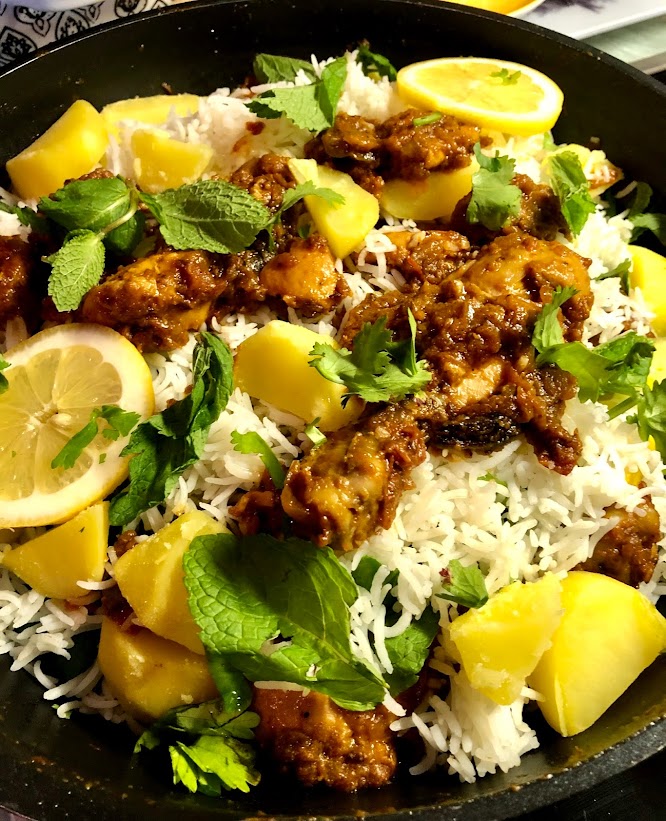
The biryani consists of rice, chicken, potatoes, lemon, mint and coriander
Though Tanzeela definitely identifies as Pakistani, I would maybe call her a 'Pakipolitan', borrowing from the existing 'Afripolitan' concept. She has lived in Pakistan during her teens, but has also lived in the US and Germany for many years. 

The biryani with the raita

She is very effusive about all of the good sides of her country, not just the amazing food, but the beautiful countryside, the colourful 'truck art' and especially the hospitable population. She also has a painting in her living room showing the beauty of a sky filled with kites during a kite flying competition. However, these sadly turn out to be banned for the moment, as the competition had literally become cut throat. The glass coated string meant to cut through the competitors strings had become so strong that accidents happened where bystanders got their throats slit by a taut string, specifically the metal ones. 

Apart from these competitions, Tanzeela swears Pakistan is a very safe country, and is frustrated that the number one question she gets asked in Europe and the US is if she 'feels safe' in Pakistan. When I ask her about Malala, it seems the main reason Tanzeela is conflicted is because all the publicity she generates is basically negative for Pakistan. Whereas Tanzeela feels the restrictions to education for girls are limited to only a few regions within the country. In her own circles, education for girls is encouraged. At the same time, after marriage, a well educated woman would normally only be expected to work if it was 'her passion.' It is a source of pride for the husband to be able to provide for his wife, so that she does not need to work for the extra income. Regarding cooking, it is interesting to note that though the woman is responsable for the cooking (in affluent households with the help from staff), it is the husband who is the one who does the shopping for the ingredients. This would be based on his wife's requests. In the case of a biryani like we are having tonight, the shopping list would include rice, chicken, onions, garlic, potatoes, tomatoes, lemons, mint, coriander, green bell peppers and chilli peppers.
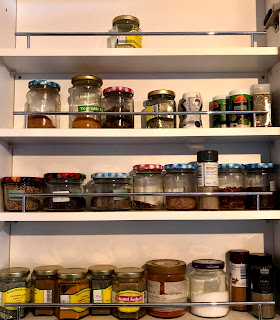
Tanzeela's spice cabinet
 In the home, there should be a well stocked spice cabinet with cumin, star anise, cinnamon, cloves, black cardamom pods and brown mustard seeds. The spice rack in Tanzeela's home (see photo) is one of the most impressive I have ever seen in a private home. The end result is truly delicious. After cooking the rice, it is layered in the pan with the chicken in sauce, the herbs and lemon slices. This allows it to be infused with these flavours, rather than completely mixed in like with pilau, another typical rice dish, where the flavour is more uniform. With this biryani, I love all the separete little taste explosions with each mouthful. The lemon, mint and coriander especially can all really be tasted individually. The chicken is super tender and moist. The yoghurt based raita adds a cooling touch, though for me this biryani has been adapted a bit to not be overly spicy. Tanzeela does explain that there are 180 ways to prepare a biryani, and this is only one, based on the Sindhi style which she prefers, even though she is Punjabi herself.
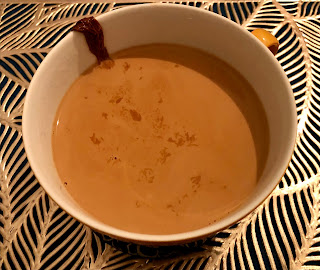
The chai with the draped malai (milk skin)

After two generous helpings of the biryani, I am treated to a traditional chai, where the tea (from Pakistan!) and spices (here just cardamom, though ginger and fennel seeds can also be added) are boiled together with the milk. Poor Tanzeela is distracted by all my questions about culture and identity, and the milk boils over while she is looking at me while answering one of my questions. However, the situation is quickly salvaged, and we soon sit down with the chai. Tanzeela shows me it is traditional to pluck the thin film from the tea (the malai) and drape it over the edge of the cup (see photo). This is followed by another 'moreish' dish, a dessert with a British twist called 'Custard Trifle.' It is made with fresh marble cake, mango flavoured custard and dessicated coconut flakes, quite different from the traditional Trifle I had for my 'English meal'. Again, I end up going for a second helping! 

As we say goodbye, Tanzeela again expresses the wish that I can at some point actually visit Pakistan, to
discover in person what she has been telling me about. Based on her cooking and the mouth watering descriptions of lots of different streetfood, I cannot wait to try all the options. Though maybe all 180 varieties of biryani might be a bit too ambitious!
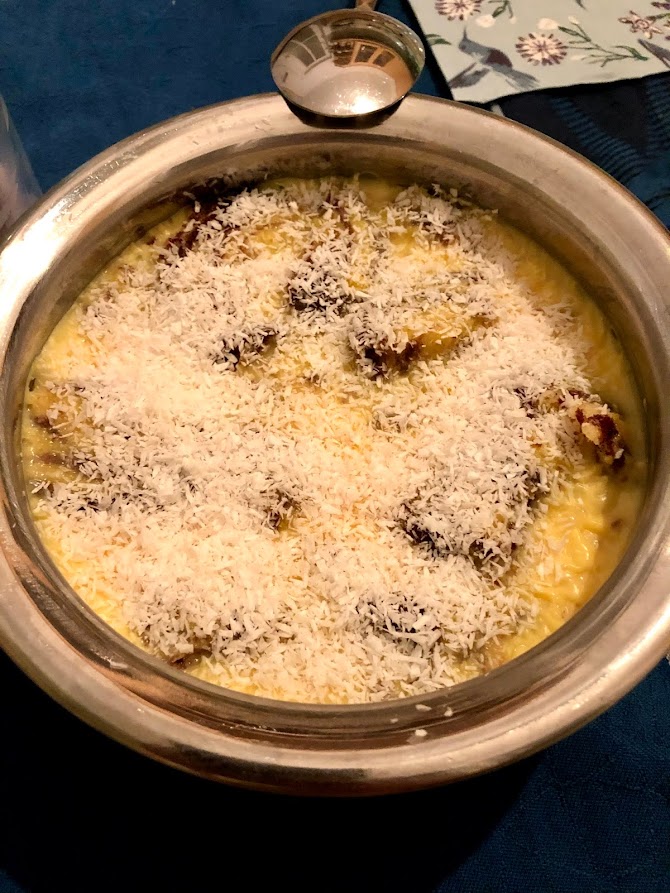
The custard trifle, a British-Pakistani fusion dish!