Friday, 30 April 2021

Meal 68. Mexican fish tacos from Baja California

Rodrigo
This is one of the few times in my life that I am having authentic home cooked Mexican food, made by a Mexican. However, I did work as a waitress at a Mexican restaurant in Holland! And my Californian father frequently prepared enchiladas and tacos, though never with fish. My gracious host, Rodrigo (or Rodri, or even Ro), has lived there his whole life, only arriving in Berlin a few months ago. He grew up in the North of the country, in Baja California. I know this is quite a pretty area with many tourists. In fact, his parents moved there before he was born, to help design and build hotels - they are both architects. His Catalan grandparents came from Spain to Mexico in the 30s, fleeing the civil war, amongst the hundreds of thousands who left Spain and around 22,000 of those who ended up in Mexico. Rodrigo grew up in Cabo San Lucas, which was a small town when he was a child, but has grown into a premier tourist destination due to its beautiful beaches and ocean views. Oddly, it is somehow a bit isolated from the rest of Mexico, as it is located a the very Southern tip of the Baja California peninsula. He did get
to know more of the country later, also living in the huge metropolis Mexico City. He highlights that the capital is actually quite liberal (especially in the Latin American context) with gay marriage legalized there in 2009 already. 

The fish marinating in lime juice
With regards to cuisine, Mexico, like many other large countries, has strong regional variations, with this evening's taco de pescado a staple in Baja California, where fresh seafood is plentiful and cheap. The base is the internationally known tortilla, which in this dish would normally be a flour tortilla, though corn tortillas can also be used. Traditional housewives in small towns might make tortillas themselves, but the overwhelming majority of Mexicans nowadays will buy them ready made. Rodrigo has trekked to a special Tortilleria in a different part Berlin earlier today to get good quality ones. The strips of fish are marinated in lime juice and then covered in a batter made with flour and beer (Corona!). They are fried till crispy, then added to the tortilla which has been warmed in a clean dish towel in the microwave. Thin strips of raw cabbage are added, as well as pico de gallo, which consists of chopped tomato, hot pepper, onion, cilantro and lime juice. Then, a bit of mayonaise is squirted on top, and finally some hot sauce to taste. The end result is sunshine on a plate, with all these fresh flavours combining in your mouth. My main challenge was to get everything into my mouth within the tortilla. Inevitably, I had overfilled it and quite a few morsels fell back on the plate during the eating. Rodrigo helpfully mentioned most people would bow down their head a bit to make it a bit easier. 

Intermediate stage: flour tortilla with battered fried fish and strips of cabbage

The Corona beer we have on the side is served with salt on the rim of the glass, and a bit of lime, a so-called Michelada. Other variations include adding hot sauce, Maggi sauce or clam juice. Rodrigo mentions a way of drinking tequila which involves orange, salt, chili and worm powder! The kind of worm you would find in a bottle of tequila (with is actually a moth larva aka caterpillar). Rodrigo mentions 56 species of insects are consumed in Mexico, including some quite expensive varieties like escamoles, ant eggs or larvae, which are equivalent to caviar in their reputation for luxury. This particular example made me smile, as the chimps I followed during my work in Ivory Coast really loved eating ant eggs and larvae as well!

Rodrigo squeezing on the lime
Finally, we discuss some of the different groups within the Mexican population. In Baja California, many have descended from whites who came to the country from the States or from Europe. A light skin colour (Rodrigo mentions the term whitecican or whitexican is sometimes used nowadays) definitely is associated with a higher socio-economic class. It would be extremely unusual to see a white person cleaning the street. What I definitely did not know, was the different lighter skinned minorities are quite close knit and often keep their networks intact clubs based around culture and religion. Hence you might not just have community centres for descendants of Lebanese or Jewish immigrants, but also for the different regions of Spain. The Basque, Galician and Catalan clubs promote the music, traditional dances, sports or language from the region. In reality, it may be more important that they function as a social network, which helps facilitate business transactions and even marriages amongst members. Interesting is also that the different ethnicities dominate different trades. For instance, the Romani gypsies are known for selling cars and textiles and Catalans for owning hotels. When I mention I once met a Mexican girl whose family with Chinese roots owned a supermarket chain, Rodrigo immediately guesses her last name correctly. He even used to shop at their stores regularly!

The fish is covered with the vibrant pico de gallo, just waiting for the final squeeze of lime!


Wednesday, 7 April 2021

Meal 67. Dominican sabrococho - a vegan variation of sancocho

Rafa chopping up the assorted veggies
 As my host for the evening, Rafa, starts chopping up the vegetables, he gestures towards the bottle of Mamajuana on the table. This typically Dominican drink consists of rum, wine, herbs and honey (and has nothing to do with marijuana!). It has a truly unique taste. The herbs used are apparently based on those used for infusions by the native Taíno. Though there are not really any 'pure' Taíno left in existence, their DNA is still present in many Dominicans (as well as Cubans and Puerto Ricans). Rafa explains that in the Dominican Republic (shortened as DR in English in RD in Spanish) citizens need to have their ethnicity on their ID card. Most are a mix of white (Spanish), Taíno and African, and "a bit of all the other races that have passed and stayed on the island." But there is some resistance to chosing the label 'black,' hence many go by indio oscuro (dark Indian). To some extent, this distancing from the population's African roots may have something to do with DR wanting to distinguish itself from its neighbour, Haiti. Rafa mentions that if he were to walk around in Santo Domingo with his curly hair and African inspired t-shirt, he would be sure to attract critical comments. Curly hair for men is normally camouflaged by cutting it short. For women, an army of Dominican hairdressers is known worldwide for their magic capabilities of transforming the frizziest of hair to sleek tresses. It is almost unheard of to leave curly hair natural. Rafa can even recall a polemic where the Education minister apparently refused a scholarship to a student due her natural frizzy hair.

After adding chia seeds, pollen, etc

Apart from Rafa's appearance, his eating habits are not 'typically Dominican' either. He has been a vegan for a bit more than a year now, and also cooks without oil. So tonight, the traditional sancocho has gotten a makeover and has been renamed sabrococho, a play on words with the Spanish sabroso (tasty). In the Dominican Republic, this soup or stew is traditionally prepared on rainy days. Variations of this dish are quite popular all over the region. It is similar to the Costa Rican olla de carne and the Chilean cazuela which featured on this blog many years ago. It is normally a broth with a mix of corn, potato, sweet potato, onion, meat and whatever you might want to throw in. The exact recipe varies per household, per cook, and depending on what is available. Rafa tosses in a few ingredients that might not be found in most Dominican cupboards, like chia seeds, bee pollen, cauliflower and an apple. He insists that the spirit of improvisation is typical of a Dominican sancocho. The end result is quite tasty, with every spoonful a bit of a surprise. Rafa admits to only learning how to cook after moving from his island of birth. He partially blames the machista culture for this lacuna. In his early days of cooking for friends in Spain, he was nicknamed the 'Terror del Paladar' - loosely translated as 'Taste Terrorist'! He says this was because "everyone is a guinea pig when it comes to a cooking experiment," but also because his combinations of ingredients were "unorthodox." However, they did always manage to get his food down, and he has made great strides since then. 

The final result: vegan sancocho aka sabrococho


Rafa with the Mamajuana

As we eat the sabrococho and sip on Mamajuana, we listen to a varied playlist including some Dominican hits. The island is famous for its stars, often producing international bachata and merengue hits. Juan Luis Guerra is a legend, with songs that are catchy while telling a story. Rafa is not really a fan of the US born Romeo Santos, who is huge. He recalls a common joke that 'Romeo sings like Juliet', referring to the singer's falsetto tones. 

Once the dinner is done, Rafa suggests ending the evening in a classically Carribbean way, with a little dance. We pick the appropriately titled song 'Tomando Mamajuana.' Oddly, but impeccably timed, the laptop runs out of battery right after the song ends. I am secretly relieved, as my merengue skills have not improved in the 20 years since I last danced to this music, and even then I was not that great!

Monday, 5 April 2021

Meal 66. Venezuelan patacones con pollo y queso

Alba
 Though I have definitely travelled far and wide for blog meals, this is definitely the furthest I've cycled!
Alba lives in a brand spanking new area of Berlin at the exact opposite side of the city from where I live, 25 km away. I mainly decide to go by bike because it is lovely and sunny out.

Once I arrive, Alba comes to find me as I cannot immediately locate her house number. She is a stylish appearance in a well accesorized outfit, with platform sneakers and a colourful scarf. Her English is so American sounding I am amazed when it turns out she has never lived in an anglophone country. Very impressive. As I have arrived a bit later than planned, the dish is basically ready to go when I walk through the door. It is basically the most deluxe version of patacones I have ever seen (also called tostones or tachinos in different countries). This is a snack I am very familiar with, from my years living in Costa Rica and Ecuador, and also from the Colombian meal for this blog. I even used to make them myself in countries with easy access to green plantain, like when I lived in West Africa. The starchy unripe plantain can be used in dishes that are somewhat reminiscent of other starchy foods like potatoes or yucca.


The shredded chicken in the pan
For patacones, you slice the patacones in thick discs, and fry in hot oil till they are slightly soft and a pale yellow colour. Then you remove them from the oil, squash them into a flat disc with a cup or a special wooden press, then fry them again till golden brown and crispy. Sprinkle with salt and serve hot. Up till now, I have only seen them served plain, or as a side dish. Alba uses them as a platform for pulled chicken (with onions and bell pepper), grated cheese and an avocado sauce. For this lunch, they are presented beautifully on a smooth wooden plank, with the avocado-yoghurt sauce in a cute little glass bottle. I can easily imagine this being served at an upscale restaurant! Though Alba cannot explain to me how she did it, the texture of the fried plantain is somehow crisper and 'fluffier' than I have ever had. My previous experiences had a more dense consistency.

The beautifully plated patacones

Alba confesses a deep love for green plantain (plátano verde). When she had not been able to find any for a while in Germany, and finally spotted some, she immediately got eight. She easily managed to finish these in a week, before they even started to ripen. Part of what I find amazing about plantains is that you can use them as a starchy tuber when green, and as a sweet banana when ripe. Fried ripe plantain (plátano maduro) is also delicious. Apart from patacones, Venezuelans love pabellón, a very typical dish of the region consisting of rice, stewed beans and pulled beef. More unusual is their traditional Christmas food called pan de jamón, a sweet bread rolled around a filling of ham, green olives and raisins. I would love to try that, it sounds a bit like the flavour combination I loved in the Chilean empanadas I had for this blog many years ago. Those contained beef, raisins and olives. The raisins are apparently a bit of a polarizing ingredient, with half of the population loving it and the other half hating them with a passion in this savoury dish.

Alba adding the avocado sauce

After our patacones and over coffee, we talk a bit about the political and economic situation in Venezuela. Things have gotten worse and worse since Alba left five years ago, though we hardly hear about it in the news anymore. However, what Alba misses about her country (apart from the delicious food and her friends) is the open and social nature of her compatriots. She swears that even in the metropolis Caracas where she grew up, people will always greet their fellow travellers when they enter a subway car. In Berlin, she did the same in the beginning, after just moving here. As nobody would ever respond, and sometimes even glance at her with a puzzled look, she did stop doing this after a while. I can actually imagine how confused the Germans must have been at this alien behaviour! I have to admit that even I am a bit surprised that this level of sociality would survive in such a huge city. It is a bit sad that she has given it up, but she assures me she does still greet the people she passes by in her neighbourhood. And they do reply, mostly. However, she jokes that her cat, who is very cute and adventurous, has made friends with the neighbours quicker than she has!

The finished product: patacon with shredded chicken, grated cheese and avocado sauce

Saturday, 3 April 2021

Meal 65. Pakistani Sindhi biryani with raita and custard trifle

Tanzeela layering the biryani
I have seldom met anyone so happy to cook for me as Tanzeela - she messages me the day before the dinner that she has been excited all week! Is it impossible not to smile in her presence, as she is so warm, open and welcoming. Lucky for me, her cooking skills turn out to be as memorable as her charm. I have little knowledge of what Pakistani food involves; it is much less well known than Indian food. Interestingly, in Berlin there are quite a few restaurants that advertise themselves as 'Indian-Pakistani', something I had not seen before. Tanzeela tries to explain some of the general differences between the two. Though Pakistani cooks use similar spices as their neighbours, she says the taste of the base ingredients (vegetables, chicken, etc) can still be detected when she cooks, rather than being overpowered by the spices used. She absolutely loves cooking and hosting, and before corona hit, was even planning to start a kind of pop-up restaurant featuring Pakistani food, called 'Desi Hut'. I was slightly confused by the term desi. I mainly remember seeing it in a funny 'Growing up Desi' video by Indian-American comedian Hasan Minhaj. But apparently it applies to the whole Indian subcontinent (and their diaspora!). It comes from the Sanskrit word for 'country' (desh).
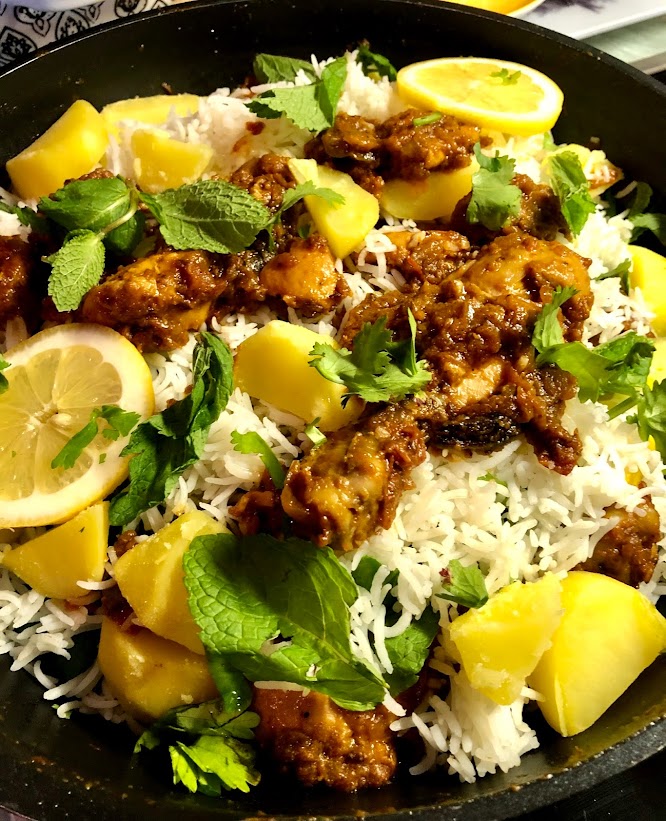
The biryani consists of rice, chicken, potatoes, lemon, mint and coriander
Though Tanzeela definitely identifies as Pakistani, I would maybe call her a 'Pakipolitan', borrowing from the existing 'Afripolitan' concept. She has lived in Pakistan during her teens, but has also lived in the US and Germany for many years. 

The biryani with the raita

She is very effusive about all of the good sides of her country, not just the amazing food, but the beautiful countryside, the colourful 'truck art' and especially the hospitable population. She also has a painting in her living room showing the beauty of a sky filled with kites during a kite flying competition. However, these sadly turn out to be banned for the moment, as the competition had literally become cut throat. The glass coated string meant to cut through the competitors strings had become so strong that accidents happened where bystanders got their throats slit by a taut string, specifically the metal ones. 

Apart from these competitions, Tanzeela swears Pakistan is a very safe country, and is frustrated that the number one question she gets asked in Europe and the US is if she 'feels safe' in Pakistan. When I ask her about Malala, it seems the main reason Tanzeela is conflicted is because all the publicity she generates is basically negative for Pakistan. Whereas Tanzeela feels the restrictions to education for girls are limited to only a few regions within the country. In her own circles, education for girls is encouraged. At the same time, after marriage, a well educated woman would normally only be expected to work if it was 'her passion.' It is a source of pride for the husband to be able to provide for his wife, so that she does not need to work for the extra income. Regarding cooking, it is interesting to note that though the woman is responsable for the cooking (in affluent households with the help from staff), it is the husband who is the one who does the shopping for the ingredients. This would be based on his wife's requests. In the case of a biryani like we are having tonight, the shopping list would include rice, chicken, onions, garlic, potatoes, tomatoes, lemons, mint, coriander, green bell peppers and chilli peppers.
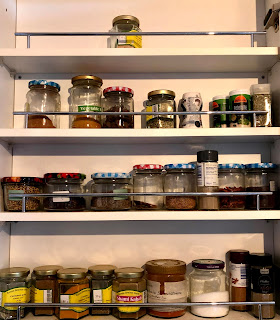
Tanzeela's spice cabinet
 In the home, there should be a well stocked spice cabinet with cumin, star anise, cinnamon, cloves, black cardamom pods and brown mustard seeds. The spice rack in Tanzeela's home (see photo) is one of the most impressive I have ever seen in a private home. The end result is truly delicious. After cooking the rice, it is layered in the pan with the chicken in sauce, the herbs and lemon slices. This allows it to be infused with these flavours, rather than completely mixed in like with pilau, another typical rice dish, where the flavour is more uniform. With this biryani, I love all the separete little taste explosions with each mouthful. The lemon, mint and coriander especially can all really be tasted individually. The chicken is super tender and moist. The yoghurt based raita adds a cooling touch, though for me this biryani has been adapted a bit to not be overly spicy. Tanzeela does explain that there are 180 ways to prepare a biryani, and this is only one, based on the Sindhi style which she prefers, even though she is Punjabi herself.
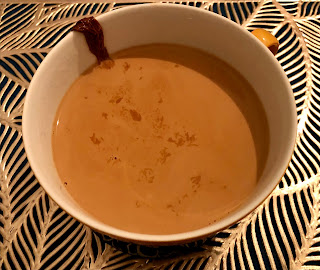
The chai with the draped malai (milk skin)

After two generous helpings of the biryani, I am treated to a traditional chai, where the tea (from Pakistan!) and spices (here just cardamom, though ginger and fennel seeds can also be added) are boiled together with the milk. Poor Tanzeela is distracted by all my questions about culture and identity, and the milk boils over while she is looking at me while answering one of my questions. However, the situation is quickly salvaged, and we soon sit down with the chai. Tanzeela shows me it is traditional to pluck the thin film from the tea (the malai) and drape it over the edge of the cup (see photo). This is followed by another 'moreish' dish, a dessert with a British twist called 'Custard Trifle.' It is made with fresh marble cake, mango flavoured custard and dessicated coconut flakes, quite different from the traditional Trifle I had for my 'English meal'. Again, I end up going for a second helping! 

As we say goodbye, Tanzeela again expresses the wish that I can at some point actually visit Pakistan, to
discover in person what she has been telling me about. Based on her cooking and the mouth watering descriptions of lots of different streetfood, I cannot wait to try all the options. Though maybe all 180 varieties of biryani might be a bit too ambitious!
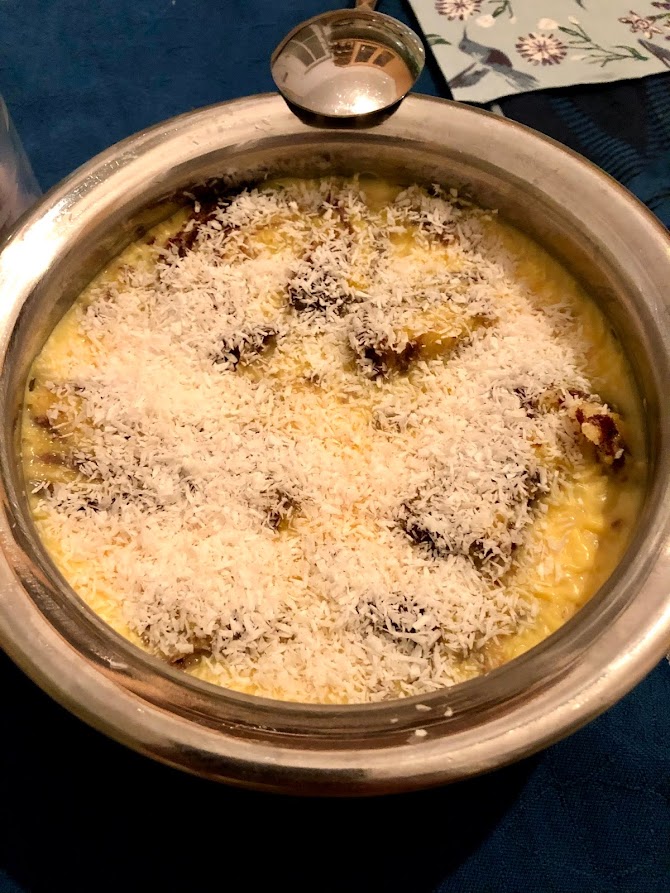
The custard trifle, a British-Pakistani fusion dish!

Monday, 29 March 2021

Meal 64. Bengaluru (Bangalore - South Indian) masala dosa, sambar & potato palya

Consummate foodie Shyam
 Shyam, my host tonight, has convincingly argued that it is completely reasonable to have more than one Indian meal for this blog, as the huge country has significant regional variations. He does not need to twist my arm too much, as the Bengaluru masala dosas he promises sound delicious, and many other have said the same before.

Though I have eaten in dozens of Indian restaurants all over the world, I have only seen (and eaten) the characteristic dosa (a fermented pancake) in one. This was in 2007, in the Wimbledon neighbourhood of London, not only known for its tennis but also for the great selection of South Indian restaurants. Not coincidentally, this was also the only Indian restaurant I was ever taken to by a (South) Indian friend.

Dosa, a thick pancake made with rice and lentil flour, is a shining representative of this region. You would not find it in North Indian cooking like the Bihari feast that was prepared for this blog by the lovely Anjana many years ago.

Funnily enough, I did recently watch a whole YouTube video of dosa being prepared by Mindy Kaling and Kamala Harris, who are both of South Indian descent. Shyam knows exactly what I am talking about when I mention the video. However, Mindy Kaling has taken a bit of shortcut for convenience, buying ready made dosa batter. Shyam has prepared his 48 hours in advance, so that is has had a chance to ferment properly in the cold German climate. Any self respecting Bengaluru family will have a batch of dosa or idli (similar but with less rice) batter on standby. 

Dosa batter, fermented for 48 hours

The batter (at left) is made with one part dal (lentils) and three parts dosa rice. When I mention that this seems to be a dish that I would not be confident making myself at home, Shyam persuasively manages to pull me back in by telling me about a shop right around the corner from where I live, TS Foods, which sells ready made batter. He also recommends their freshly made samosas (as do a few of their 800 Google reviews!).

South Indian Kodubale snacks

Shyam is a real foodie, who learned how to cook from his father, who often makes the family meals, as well as from his mother. However, he has mainly had to put this skill to use after moving abroad, having lived in Singapore, Plymouth and Manchester (UK) before moving to Berlin. He studied Business Management in Plymouth and has fond memories of cooking for his fellow international students. He has less fond memories of venturing into town and hearing mutterings at least once of week of "go back where you came from" or "brown bastard"...and being told by fellow students not to venture out alone after dark to avoid agression from (drunk) Plymothians. I am genuinely shocked by such a high frequency of overt racism. Shyam does offer, as a kind of reassurance, that this type of behaviour was almost absent in Manchester and London. We discuss how the same people who felt the need to spout abuse at him might also regularly enjoy a curry (now apparently Britain's most favourite dish). Though food does open doors to new cultures, it does not always open them very wide. 

Dosa in crêpe pan, with dal and potato palya

The dish I am having tonight consists of four elements. The thick dosa pancake itself is spread with two different sauces, one with a lentil base, the other with a potato base (the palya), then folded double and dipped into an aubergine and courgette stew (the sambar). These are enhanced by a selection of the typical South Indian flavours: cumin, chilli powder plus dried whole chillies, garam masala, asafoetida, mustard seeds, fenugreek, ginger, garlic, turmeric, curry leaves, coconut, and tamarind paste. Shyam has kindly dialed down the chilli content somewhat. He has learned from his mistake after a friend tried a truly genuine Bengaluru meal and almost passed out. Bengaluru is the less familiar (to me) spelling of Bangalore, but much closer to how the name of the city is actually pronounced. However, this spelling was only officially implemented relatively recently, locally in 2006 and nationally in 2014. It is similar to Bombay now being spelled Mumbai. I joke that the huge Indian film industry, Bollywood, was never renamed Mollywood to reflect this change, and share my recent 'discovery' with Shyam that a third of the global top YouTube channels are Bollywood companies. Of course, this makes some sense with India having more than a billion inhabitants, and the government not blocking YouTube like in China! 

Shyam in now studying Internation Marketing, and I take advantage of this background to ask him what he thinks of the controversial but sadly commonplace marketing of lightening skin creams in India by international brands like Unilever and L'Oreal. He agrees that the source of the problem is the widespread 'colourism' within India, with a strong preference for 'fair' skin tones. However, the huge budgets that go into tv, print and billboard advertising by conglomerates clearly exacerbates existing prejudices. He shares the news that only last year the Indian government has moved to ban these type of commercials. Unilever has already made a small step recently by renaming their top Indian skin care brand from 'Fair and Lovely' to 'Glow and Lovely,' and removing the so-called 'shade card' from their advertising. However, 'fairness' is still highly valued in marriage partners, as was also recently highlighted by the popular Netflix reality series 'Indian Matchmaking'...a guilty pleasure in which both Shyam and I have indulged.

The main meal - folded dosa with filling, to be dipped in the bowl of sambar

After two dosas I am stuffed. They are very filling, though it might not have helped that I snacked on the appropriately regional Kodubale snacks while Shyam was preparing the main meal. He is touchingly evangelical about his region's kitchen, making sure I take home some extra sambar in a tupperware container. As I am putting on my coat, he even presents me with two special culinary presents to help me have some authentic South Indian breakfast at home; directly imported by him from Bengaluru, and not even available for sale at TS Foods!


Tuesday, 16 March 2021

Meal 63. Ukrainian varenyky

 I'm quite excited to have another meal for my blog after an extended hiatus (due to working in an isolated
rainforest location). My charming host is Dima, who grew up and still lives in a small town 30 km from Kiev/Kyiv, the capital of Ukraine. I have been told weeks ago (by the friend who introduced me to Dima) that the country is now referred to simply as Ukraine and not the Ukraine (since independence in 1991). I find it surprisingly difficult to remember. You can imagine there are many occasions to practice this evening! It is reassuring to find out that even Obama has slipped up a few times in the past. Though using the pre-independence 'the' can be politically sensitive, Dima kindly never corrects me...because he knows I am aware of the issue, and he prefers not to interrupt!

During the preparation of the varenyky, which is quite a lenghty process, we do get into some historical and political issues, including the gruesome Holodomor, a mass famine which killed millions of Ukrainians in 1932-33. I only had a very vague knowlege of this when Dima mentioned it, but will not forget it again soon. Especially after hearing Dima's grandmother could recount stories of a neighbour so crazed by hunger that he killed and ate several children in the village. Turning to cannibalism actually was widespread during this year of terror, incredible as it may seem. The Soviet central government was the direct cause of the famine, setting unrealistic quotas for the kolkhozes (communal farms) and enforcing them brutally. It is not hard to imagine anti-Russian sentiments linger, compounded again and again by more recent events.


I actually have ancestors from Ukraine myself. My Jewish-American grandmother's parents both grew up there (in Zhitomir, then 35% Jewish) but came to the US in the 1910s, long before the Holodomor. They left Ukraine due to the unpleasant atmosphere for Jews in those days. We still have photos of my great-grandfather Jacob painting pottery in a Ukrainian workshop. Apart from pottery skills, he and his wife also brought a love of the local cuisine with them, which was passed to their daughter who then taught my father how to cook. Unsurprisingly, his 'Jewish-American' meal for this blog actually features dishes which are all familiar to Dima. Though I love borsht, I am quite happy not to have a repeat of it; apart from my dad's version, it has also been featured in the Belarusian and Lithuanian entries already!

Lucky for me, Dima has chosen for the labour intensive varenyky dumplings. He has prepared the dough (flour, water, egg and a tiny bit of oil) in advance, to let it 'rest' for a bit. As quite a few other hosts for this blog, he has called his mother beforehand to check a few details to make it truly authentic. She has advised him that the consistency of the dough should be supple; "it should feel like your earlobe between your fingers!" I love this description. 

For this version, we have two different fillings: diced chicken and mushrooms, both fried up with onions.

The shaped dumplings ready to be boiled

Ideally, the mushrooms would be wild ones, collected in the woods, but due to matters of convenience, Dima has opted for storebought chestnut mushrooms. Once the filling is prepped, the dough is rolled out and circles are formed with a glass. A spoonful of chicken or mushroom mix is dropped in the middle and the sides are simply squeezed together to shut firmly. I help out and my first attempt looks like a malformed triceratops (you might be able to spot it in the photo at the right). Thankfully progress is quick, and my subsequent efforts are deemed acceptable. 

The dumplings are boiled for a few minutes, then fried up in butter, and served with lashings of sour cream and crispy fried garlic. Dima proudly sends a quick pic of the final results to his mom, and within seconds receives the joking reply:"And it only took you five hours!" We share a laugh and quickly dig in before the varenyky get cold. Very hearty, and true comfort food. Having seen that the amount of work involved is intimidating, I might try to get some frozen ones to create an easier approximation at home. Dima has done this often as well, though the taste is obviously not quite as good. The one thing you definitely cannot skimp on is the amount of sour cream, an important element of Ukrainian cuisine in general and crucial for the success of this dish!

The boiled and fried dumplins with crispy garlic, sour cream and a side salad.


Tuesday, 19 March 2019

Meal 62. Taiwanese hot pot (three ways) and bubble tea

Enoki mushrooms, cabbage and broccoli
Chia-Heng kindly lets friends in London call her Joyce, because it is easier to remember, similar to my previous hosts Mike from China and Bibi from Thailand... She and her friend I-Ting (simple enough to pronounce that she does not 'need' a European name!) are both vets from Taiwan specializing in wildlife medicine. I have been lucky enough to try their crispy fried chicken a few months ago at a potluck dinner, but tonight the Taiwanese food takes center stage, with 'hot pot' prepared in three different ways. We are with eight people, but when we enter the kitchen, it appears Chia-Heng and I-Ting have procured supplies for about twenty. All the available surfaces are covered in chopped vegetables, including the string like enoki mushrooms (see photo left), which are quite appealing visually.
The three different pots simmering
Chia-Heng tells me that Taiwanese food, in general, is quite similar to 'mainland Chinese food', though it is worth noting there are still differences, also within Taiwan, with food from the North saltier and from the South sweeter. This was the exact same distribution described for Vietnam by An, who cooked for this blog many years ago, though she also mentioned that the center of her country produced spicy food.
Hotpot with 'seafood tofu' and Szechuan spices
Three different hot pots of broth are simmering on the stove stop, including one which is relatively spicy with Szechuan peppers, from a mix by Heidi Lau. Anhui, a Chinese-Singaporean friend present, immediately notices the packaging, pointing out the brand is known internationally for being towards the high end, very good but a bit expensive! I am proud that I am able to 'take the heat' and eat all the items with my chopsticks without dropping anything.
While we listen to a selection of Taiwanese music, Joyce explains that she only really got into cooking when she spent six months in the US with a lot of time on her hands and missing Taiwanese food. I have heard similar stories for many of the people who have contributed towards this blog; many only learned the recipes while away from home as the only way to get access to the familiar tastes from back home.
Chia-Heng and I-Ting serving up the food
The second and third hot pot are cooked in a milder broth, and the very thinly sliced beef and lamb acquires a special 'frilly' texture with a nice mouthfeel. I try to taste all the different broths and ingredients, but after four plates I am definitively stuffed...I think.
As we laugh at the hilariously nineties feel of Taiwanese the hit song 'Bad Boy' by diva A-Mei, I-Ting hands out some special sweets her mother sent her recently, made with chestnut (I create a bit of extra space for these!) and Chia-Heng starts preparing the 'pearls' for the bubble tea. The tapioca balls are slightly sweet and glutinous. They are most enjoyably slurped up with a big opaque straw so you cannot tell when you are sucking them up, so it is a surprise when one or two land in your mouth. My infantile sense of humour shines through when I cannot resist showing them a sign I remembered seeing online from a bubble tea shop in Thailand. The cartoon cup tells customers 'Hi, I am bubble tea!' and two panels later: 'Suck my balls!' Apparently, you can get just the latter printed as a t-shirt too...
Hot pot with finely sliced lamb


Picking out the best bits with chopsticks
On a more serious note, we discuss how Taiwan is mainly populated with descendants of Han (mainland Chinese), who started arriving in the 17th century, with the original indigenous population now a small minority, and many of the indigenous Austronesian languages either extinct or endangered. Having been schooled in the Netherlands, it is surprising I never realised the role the Dutch (East Inda Company) played in Taiwan around this time - establishing a trading post called Fort Zeeelandia and losing it all a few decades during a bloody siege. Chia-Heng mentions that because the Dutch colonised Taiwan for quite a long period, there are some Taiwanese people with a bit of Dutch ancestry, some with slightly reddish hair. Her mom thinks there might be some Dutch genes in Chia-Hengs family as they are so tall! I only have a faint memory of high school history lessons in the Netherlands covering Chiang Kai-Shek, whose Kuomintang party retreated from mainland China to Taiwan in 1949. I never learned (or maybe just forgot) that he led Taiwan for decades, till his death in 1975.
I was aware (as most of us are probably are) of the odd situation where the People's Republic of China does not acknowledge Taiwan (called Republic of China by some) as an independent sovereign state. However, we do not really go into this topic during dinner, prefering to focus on the some other aspects of life in Taiwan, including the special musical garbage trucks utilized by its amazingly succesful recycling programme - one of the world's most efficient!
To sweeten the bubble tea, some amazingly poetic descriptions of tasting sweetness on the packet of sugar!