Showing posts sorted by relevance for query lithuanian. Sort by date Show all posts

Sunday, 1 February 2015

Meal 35. Lithuanian Barščiai and Potatoes with Dill


It's the first time I eat barščiai for this project, but not the first time I eat "borsht", an easier way to spell it in English. As you can see in meal 11, where it al revolves around my father's beetsoup.
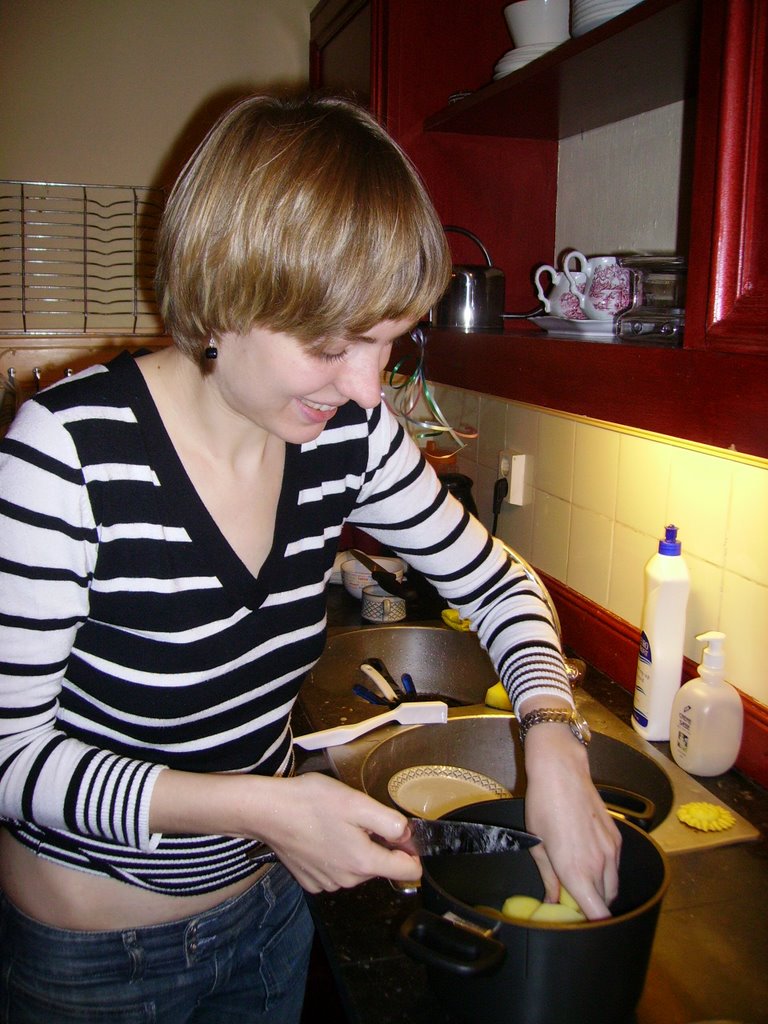
Gintare (which means "amber" in Lithuanian) is preparing the soup as her grandmother always did it. This recently graduated sociologist does agree the barščiai she is making is similar to many other beetsoups around the world, though for example in Belarus they would add cabbage.
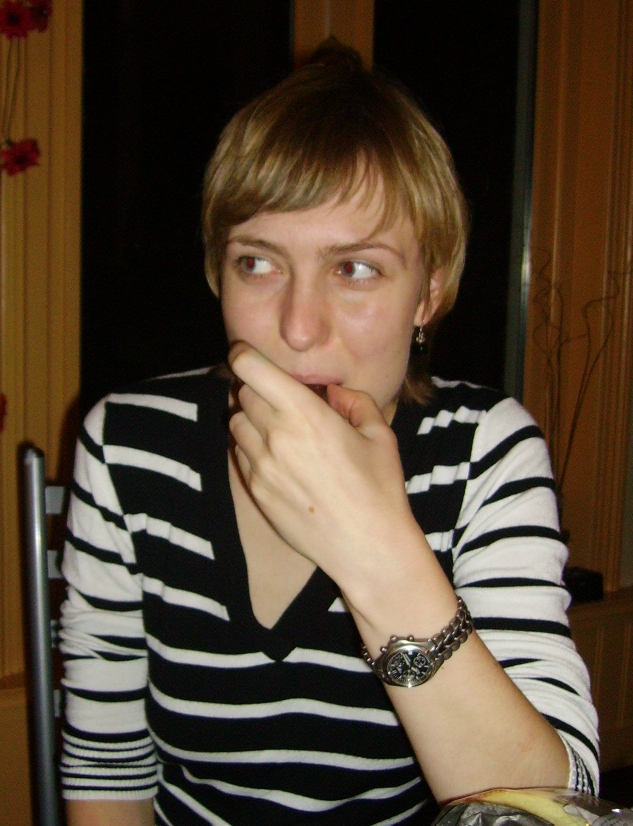
Secretly I am glad we are not eating another local specialty, smoked pig's ear, which is served as a snack with beer. While Gintare is preparing the potatoes, we sip on tea and gobble up some yummy chocolates she brought from home. She's only really lived in the Netherlands for a short time, but sometimes feels frustrated by the language and the bureaucratic procedures. Recently she was called by a girl, who had found Gintare's name through some list of expat Lithuanians. She called and explained her situation, and Gintare commiserated :"Oh yes, I know how you feel...", but then found out while she had only lived here for 2 months, this girl had lived here for over 3 years!

There aren't that many compatriots in Groningen, though she will also feel immediate bonding with Latvians, who speak almost the same (Baltic) language and have a similar culture.
I ask:"What about Estonians?", also a Baltic state, after all.
"Oh no! They are much more similar to the Finnish...a bit more reserved as well."
Well, that's good to know. I wouldn't be surprised if the Dutch were compared to the Flemish, but I would if they were deemed similar to the Germans.
I will ask the Latvian girl who will be cooking for me in December what her opinion is on the matter...
Vilnius (Lithuania) and Riga (Latvia) are now part of Europe and sadly, both are becoming popular destinations for Brittish "stag parties", involving drunk young lads looking for a cheap alcohol and pretty girls. They don't show too much appreciation for its beautiful baroque city centre.
I hope an advantage of joining the EU is an improvement in dental care. Gintare tells me a story about barbaric practices during her childhood including drilling in teeth without painkillers. She was so scared of the dentist she didn't go for seven whole years. At the end of this period, two weeks of dental work were needed to repair the damage!
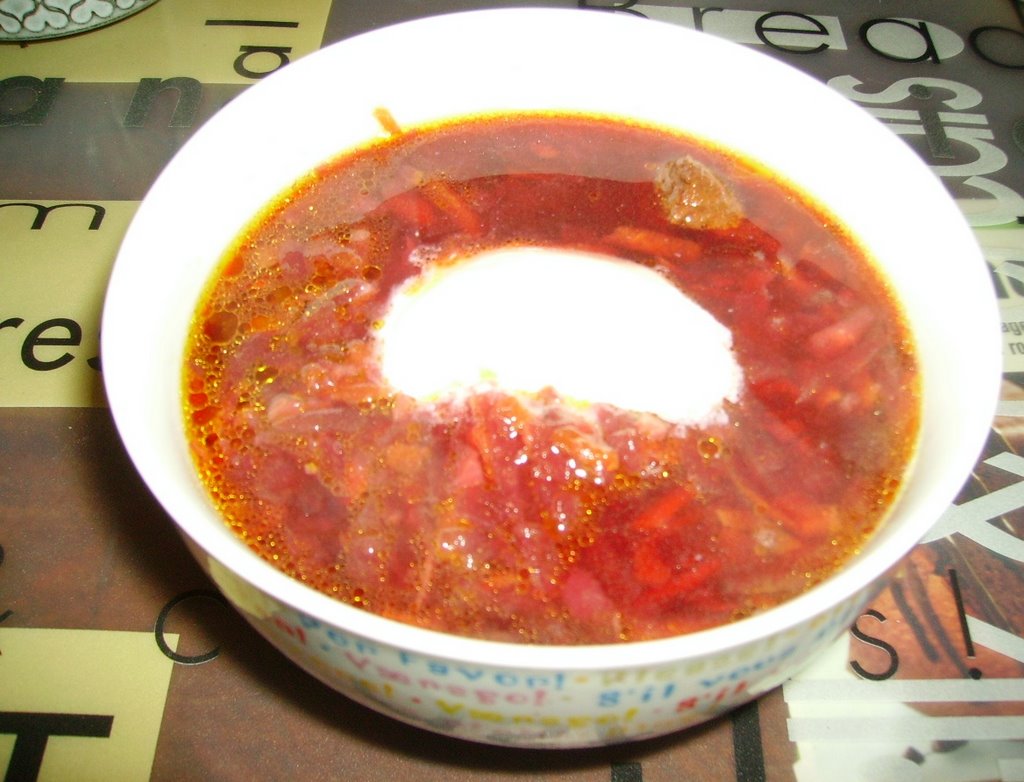
The soup is delicious, by the way...Gintare's grandmother would be proud.


The potatoes fried in butter with dill are served on the side and are such an easy and effective side dish, I promise myself to make it one day soon. I have to admit, for the borsht/barščiai I will use my own grandmother's recipe!

For those without these loyalty issues, try the Lithuanian version.

(The original post about this meal is from November 11, 2006)

Tuesday, 16 March 2021

Meal 63. Ukrainian varenyky

 I'm quite excited to have another meal for my blog after an extended hiatus (due to working in an isolated
rainforest location). My charming host is Dima, who grew up and still lives in a small town 30 km from Kiev/Kyiv, the capital of Ukraine. I have been told weeks ago (by the friend who introduced me to Dima) that the country is now referred to simply as Ukraine and not the Ukraine (since independence in 1991). I find it surprisingly difficult to remember. You can imagine there are many occasions to practice this evening! It is reassuring to find out that even Obama has slipped up a few times in the past. Though using the pre-independence 'the' can be politically sensitive, Dima kindly never corrects me...because he knows I am aware of the issue, and he prefers not to interrupt!

During the preparation of the varenyky, which is quite a lenghty process, we do get into some historical and political issues, including the gruesome Holodomor, a mass famine which killed millions of Ukrainians in 1932-33. I only had a very vague knowlege of this when Dima mentioned it, but will not forget it again soon. Especially after hearing Dima's grandmother could recount stories of a neighbour so crazed by hunger that he killed and ate several children in the village. Turning to cannibalism actually was widespread during this year of terror, incredible as it may seem. The Soviet central government was the direct cause of the famine, setting unrealistic quotas for the kolkhozes (communal farms) and enforcing them brutally. It is not hard to imagine anti-Russian sentiments linger, compounded again and again by more recent events.


I actually have ancestors from Ukraine myself. My Jewish-American grandmother's parents both grew up there (in Zhitomir, then 35% Jewish) but came to the US in the 1910s, long before the Holodomor. They left Ukraine due to the unpleasant atmosphere for Jews in those days. We still have photos of my great-grandfather Jacob painting pottery in a Ukrainian workshop. Apart from pottery skills, he and his wife also brought a love of the local cuisine with them, which was passed to their daughter who then taught my father how to cook. Unsurprisingly, his 'Jewish-American' meal for this blog actually features dishes which are all familiar to Dima. Though I love borsht, I am quite happy not to have a repeat of it; apart from my dad's version, it has also been featured in the Belarusian and Lithuanian entries already!

Lucky for me, Dima has chosen for the labour intensive varenyky dumplings. He has prepared the dough (flour, water, egg and a tiny bit of oil) in advance, to let it 'rest' for a bit. As quite a few other hosts for this blog, he has called his mother beforehand to check a few details to make it truly authentic. She has advised him that the consistency of the dough should be supple; "it should feel like your earlobe between your fingers!" I love this description. 

For this version, we have two different fillings: diced chicken and mushrooms, both fried up with onions.

The shaped dumplings ready to be boiled

Ideally, the mushrooms would be wild ones, collected in the woods, but due to matters of convenience, Dima has opted for storebought chestnut mushrooms. Once the filling is prepped, the dough is rolled out and circles are formed with a glass. A spoonful of chicken or mushroom mix is dropped in the middle and the sides are simply squeezed together to shut firmly. I help out and my first attempt looks like a malformed triceratops (you might be able to spot it in the photo at the right). Thankfully progress is quick, and my subsequent efforts are deemed acceptable. 

The dumplings are boiled for a few minutes, then fried up in butter, and served with lashings of sour cream and crispy fried garlic. Dima proudly sends a quick pic of the final results to his mom, and within seconds receives the joking reply:"And it only took you five hours!" We share a laugh and quickly dig in before the varenyky get cold. Very hearty, and true comfort food. Having seen that the amount of work involved is intimidating, I might try to get some frozen ones to create an easier approximation at home. Dima has done this often as well, though the taste is obviously not quite as good. The one thing you definitely cannot skimp on is the amount of sour cream, an important element of Ukrainian cuisine in general and crucial for the success of this dish!

The boiled and fried dumplins with crispy garlic, sour cream and a side salad.


Monday, 9 February 2015

Meal 52. Lebanese Sawda, Malta, Fatteh and Tabbouleh

Sahid is my generous host this evening, and as I walk onto the balcony, he asks: "What is your poison?" I opt for arak, the only Lebanese drink on offer. It is very much like pastis, but all the other guests at the dinner tut at my glass and warn me about drinking it. It is apparently so strong that you will need a bottle of water by your bed, and you can only drink it with food (mezze) or you will be knocked out cold. Heeding their advice, I sip slowly and carefully; it is delicious...and no ill effects are noted.

Sahid is incredibly hospitable and tells me that every Sunday he hosts a big fish dinner after his weekly angling trip off the coast of the Western Area Peninsula. He is one of the roughly 30,000 Sierra Leoneans of Lebanese descent (these estimates vary wildly depending on the source). The Lebanese diaspora is huge, with 'Lebanese' outside the country vastly outnumbering the ones in Lebanon. In Sierra Leone, they first arrived in 1893. Sahid's grandfather was one of the first to land and soon married a local Madingo woman. So Sahid is a bit Madingo, as well as 2nd and 3rd generation Lebanese. A portrait of his father has pride of place in the living room, an imposing figure in a flowing white gown.
Sawda, chopped raw liver

Tonight's gathering is an international affair, with Sierra Leonean, British, Irish, Lithuanian and Belarusian guests as well as varied Lebanese. Sahid and a few of the invitees tell me they feel most 'at home' with Lebanese Sierra Leoneans or Lebanese Londoners, more so than when they are in Lebanon. Sahid first set foot in Lebanon when he was 22 and confides he had to study hard to truly master written and spoken Arabic. Some part of the evening is spent discussing how crazy expensive Beirut is, how people in clubs easily drop $15,000 on a bottle of champagne or a private table and how people are quite 'money conscious' there.

The fact that there are both Christian and Muslim Lebanese does not seem to phase this gathering, who say it

Sahid showing me how to eat the liver
is all the same to them. Most have spent many years in Sierra Leone, as well as in Lebanon, the UK, Dubai, or the Netherlands. These friends tease Sahid mercilessly about him 'slaving away in the kitchen all day' to prepare everything for this dinner, and he sheepishly laughs and shrugs. I suggest his role was more of a co-ordinating and delegating host, and he smiles that this might be an appropriate description. I recognize the malta (raw beef pâté, delicious) as
remarkably similar to one his neighbour Hoda made the week before...and just as tasty! Raw meat features in three separate dishes; the malta, the spicy beef tartare and the chopped raw liver (sawda). I had been forewarned about the liver, and had promised to at least try it. Scooped up with small pieces of Lebanese flat bread, with loads of fresh mint and raw onions, it is better than I expected. The beef tartare and the malta are great, and new to me. The refreshing salads (tabbouleh and fattoush) are familiar and offer a lighter touch. I try taking a little bit of everything, including some top quality hummus and my favourite of the evening: fatteh. This dish consists of chicken, yoghurt, chickpeas, fried bread, almonds and garlic.
Fatteh, on a traditional Sierra Leonean mat
I will definitely try to get repeats of this dish somehow soon, either at friends or a restaurant. There are many
restaurants in Freetown that feature Lebanese cuisine, but I do not recall having seen fatteh on the menu before, or chopped liver.

As I hear Sahid's friends joke around in a mix of Arabic and English, I ask if they call this Aranglish. They tell me the term they use is tabbouleh, not just the name of the mixed salad, but also of the amalgam of languages.