Wednesday, 24 October 2018

Meal 60. Bosnian krompiruša and stuffed peppers

Goran
Sara squeezing grated potatoes
Goran was relatively easily talked into providing a Bosnian meal for this blog and is cooking up a storm with his younger sister Sara and our mutual friend Imogen when I arrive in his south London houseshare. Sara is squeezing out the liquid from some grated potatoes, as expressly instructed by their mother, who is on phone standby during this evening. She has very elegant fingers with long manicured nails, and as I am snapping away, I joke that if grated potatoes were my particular turn on, I would definitely choose her hands to do the squeezing! Luckily for us both, I appreciate potatoes purely for their culinary value. We are all amazed at how much liquid she is managing to remove, all to make sure the krompiruša, rolls of filo pastry with a potato and onion filling, does not turn out too wet. Goran says his mother would be delighted to see them cooking Bosnian food together, and he himself tells me later he is happy to spend more time with his sister like this. Though she is nine years younger, they are now both adults, graduated from university, and can uniquely understand each other's upbringing. The family had to flee Bosnia when the war started in 1992, and after spending some months with a family in Croatia and five years in Germany, arrived in London. It did take a while to fully settle in, as the first five years in the UK, Goran's parents (both
Stuffed peppers
economists) were not allowed to work, because they were classed as asylum seekers and waiting for their residency status to be confirmed. Goran is now a clinical psychologist and speaks with a beautiful 'BBC accent' but says the first few years, when he still had a thick German accent, were a challenge. As a ten year old, pulled away from his childhood friends in Germany, he was picked on in London for his foreign accent and was not that happy to be here. Over time, he did start identifying as a Londoner. Almost all of his friends are British, and though many have 'dual heritage', hardly any have roots from the region he and his parents were born. One of them, Janja, is here tonight. She has a Slovenian background, and it is amusing to see how excited Goran and Sara are by the bottle of rakija she brings along (a kind of schnapps), sniffing it rapturously. They also clearly bond over the typical brand of parental advice they would all receive as teenagers, and still as adults on occasion!

Goran calling mum for final guidance
The stuffed peppers contain a lightly spiced minced beef (vegan for Imogen), onions, carrot, paprika and chili, covered with a tomato sauce just before serving. These seem to be made quite confidently, but for the krompiruša a bit of last-minute phone advice from mum is needed to guarantee authenticity and success. I hear Goran animatedly chatting away in Bosnian, interspersed with the occasional English word ('filling', 'fine, fine', 'bye!'). He and Sara then give it a go, folding the first third of the filo pastry before adding the filling and rolling the sheets carefully into long cylinders. They are then arranged in an oven tray, and brushed with oil half way through to achieve that delicious crunchy/flaky filo consistency. No special adjustment is needed to make them vegan, which is why Imogen was already a big fan after a trip to the region.
Rolling the krompiruša
Once the peppers and the krompiruša are in the oven, Goran can relax a bit more as he was struggling with combining the cooking, delegating and answering questions at the same time. It turns out to be a pretty big dinner party for seven in all, with his two flatmates joining as well, one rushing over straight from the airport to make it home in time for the food.
As the krompiruša leaves the oven and the stuffed peppers are being dished up, I literally start salivating. We all tuck in and I start to understand Imogen's adoration of krompiruša, looking forward to trying some of the variations of this dish with cheese or meat fillings as well. Though Goran and Sara's mum would make her own filo pastry, with the store bought kind it is still exquisitely flaky, and looks easy enough to make for me to create an approximation at home.
Ladling up the peppers
To top it all off, we have some 'Yugoslav' coffee and Bajadera chocolates (made in Croatia) plus some 'hairy friendship cakes' as my contribution. I made them after googling 'Bosnian desserts'. The hairiness is due to the coating with desiccated coconut. Though initially a bit wary, once Sara bites into them, she exclaims that they do seem familiar, the type of thing you might be served at a Bosnian wedding.
After everyone else has left, to catch their trains or to go and meditate, Goran and I end up chatting further about his background. We touch on the sacrifices his parents made for his and Sara's education, and how much it pleases him that they can now relax in their chosen seaside retirement in Croatia. I am curious to why they would not return to Bosnia. 'It's complicated' covers some of it. Goran explains some of the historical factors, both internal and external, that led to the war in Bosnia, and mentions that the country still seems to be stuck in an impasse, very divided along religious/ethnic lines (the Muslim Bosniaks, Orthodox Christan Serbs, and Catholic Croats). The country is not doing that well politically or economically, and many young people have been leaving as they don't see a future there. However, as a lot of the former Yugoslav countries do share a very similar history, culture and language, Goran explains that much of what his parents might miss from Bosnia, can be found in Croatia too. We touch on some of the aspects he appreciates specifically of his 'dual heritage'. He highlights the British sense of humour which feels like home to him, but also the warmth and generous hospitality he associates with his Bosnian friends and family. He recalls summer visits with outside barbecue parties. For special occasions, an entire spit roast lamb or a piglet would be brought out. As the time comes for me to head home, I promise to invite him over to mine for a return dinner party, thinking the half drunk bottle of bourbon I brought with me as a gift might not quite cover the generous spirit he has just described so evocatively!

The krompiruša, stuffed pepper and Goran's special 'fuckoff' salad


Friday, 8 April 2016

Meal 59. Northern Irish Ulster Fry (Brunch)

Fried in generous amounts of Irish butter
This is the first brunch in the history of this blog project. Douglas (or Dr. Doug, as I like to call him) kindly offered this Ulster Fry as the most typical Northern Irish meal, saying most other meals he likes cooking from 'back home' are indistinguishable from just Irish (i.e. Republic of Ireland) meals. And it fits with the (relatively new) tradition of him coming to the house I share with Dr. John to make us breakfast on weekends, something I wholeheartedly support.
Doug, consciously wearing a green t-shirt this morning, regularly ate Ulster Fry while growing up, apparently one of the few meals his dad would be happy to get involved with! It is traditionally a smorgasbord of carbs and saturated fats, featuring potato bread, soda bread, pork sausages, bacon, black pudding, white pudding and eggs, all fried in the famous Irish butter...plus tea or coffee and some orange juice to cut through the grease. When asked if anything like the 'English breakfast' staples baked beans, stewed tomatoes or mushrooms make an appearance, Doug faux shudders and exclaims:"No, no, no. You can't have anything healthy in there!" With a straight face he then tells us that the portable defibrillator was developed in Northern Ireland to come to the rescue when people have heart attacks while having fatty breakfasts at home. The first part is indeed true (and a nice bit of trivia I can throw around next time I meet a doctor from Belfast). Though this meal doesn't seem conducive to good cardiovascular health, the stats actually show that Northern Ireland is roughly on par with England; within the UK it is Scotland that has significantly higher levels of heart disease.
One of the unique properties of Ulster Fry is that it all goes in one pan, apart from the eggs, which are fried up last.
Adding the bacon rashers...
The topic moves from death and disease to politics...Doug grew up near Belfast and went to school there, Ulster's biggest city, but as he was still very young when the Troubles ended, he implies it has not affected his life all that much. Though he can easily tell you which neighbourhoods (and names) are typically Catholic or Protestant, he went to a 'mixed' school and said there were definitely lots of friendships and relationships 'across the divide.' He feels the sense of difference or enmity that still remains is largely class dependent. Apart from reading a few novels about the topic many years ago, I really do not know much about the issues. Now I learn Ulster is one of the four historical provinces or kingdoms of Ireland (with Munster, Leinster and Connacht) which are now mainly used as divisions for rugby teams. Historical Ulster fits roughly with the current boundaries of Northern Ireland. It is interesting to hear Doug's synopsis of the roots of the Troubles: that Ulster was the most difficult province to control for the British government, so they consciously 'planted' lots of English settlers and gave them the best agricultural land...which sowed the seeds of future discord, leading to the 1916 Easter Rising against British rule, exactly 100 years ago (the Dublin memorial this Easter was still a bit contentious). This uprising paved the way for Irish independence a few years later.

Heapings of black pudding and potato bread in the foreground
Doug feels keenly that he has been unable to procure the most typically Northern Irish ingredient of all, the soda bread. However, he scored some top notch branded potato bread from famous chef Paul Rankin, who went to school with Doug's father (just to prove the point it is a small place). The packaging of this 90% potato based bread actually advertises a competition to "Win a Food Break to Belfast!", as it appears Northern Ireland is celebrating 2016 as the Year of Food and Drink. So having this blog entry now is very appropriate, despite neither Doug or I being aware of the fact! Belfast is apparently becoming a bit of a foodie capital, although Doug claims most people there still think the word espresso has an x in it!
The flux between Republic of Ireland and Northern Ireland is fascinating, with a special national anthem commissioned for the Irish Rugby team, which includes players from the whole island. As well - spooked by the impending Brexit - Doug has recently been able to acquire the Irish nationality to twin with his British one. I am proud to say I helped out by authenticating his photos for him, which I was allowed to do as an officially trustworthy veterinarian with a business card and work phone number. A nice touch was the colour of the forms....green, of course!
Clockwise from top: fried egg, black pudding, bacon, potato bread and pork sausage. Yum!

Sunday, 13 March 2016

Meal 58. Austrian Mohnnudeln, Marillenknödeln and Fritatensuppe

Tanja frying up the dumplings!
Tanja is one of the super qualified interns at the Institute of Zoology where I work now, with an MSc in Nature Conservation. We chatted at some after work drinks about the 'sweet meals' she remembers fondly from boarding school and she offered to make an approximation before she moves on to a new job in Cambridge. Like quite a few of the blog hosts, she has eaten these dishes often, but not prepared them more than a few times....so her mum has specially scanned copies of the relevant pages of her recipe book for the occasion!
She is vegetarian, so the famous Wiener schnitzel will not make an appearance tonight. I heard from the girlfriend of another Austrian friend that the preparation of this breaded pork dish can 'aromatise' the house for hours, if not days.
Instead, Tanja has been shopping, and slaving away in the kitchen for a few hours prior to my arrival to prep for three different veggie dishes.
Fritatensuppe (Pancake soup)
She confesses the Fritatensuppe starter is 'super easy', it's just sliced pancakes in broth and a great use for leftover pancakes. You roll then up and slice them finely, place them in a shallow bowl in a decorative way, then pour over the hot broth. The little curls in the dish look very attractive. She actually does make this regularly, as opposed to the dumpling recipes we will be having for the main course.
Mohnnudeln before they are fried
There are two types of potato based dumplings on the menu tonight: the Mohnnudeln which I can only describe as slug shaped gnocchi: potato dough steamed, fried in butter and covered in poppy seed with a bit of powdered sugar, then served with a fruity sauce. Tanja was planning to have it with plum sauce, but ended up buying a tin of prunes. I have an irrational dislike of prunes after ordering ice cream with chopped up prunes in Vienna more than ten years ago...something about the texture just freaked me out. In a sauce I would probably love them, but in this case, Tanja runs out of time to make a the prune sauce and opts to serve it with strawberry jam made by her grandmother, which is an honour. The jar looks pretty professional, with a store-bought 'Made by Granny' label on the home-made jam.
Prepping the Marillenknödeln

There is something of a guilty pleasure about eating this sweet dish as the main course, and I can imagine the excitement of being at boarding school as a teenager and looking forward to the Wednesday evening delicacies. Tanja says most people will know this dish either from their grandmother or from typical restaurants or ski huts. When she was young she did not actually like the poppyseeds. However, she has started to appreciate them as she grew older and is very happy she could buy a decent sized bag of the seeds at the supermarket down the street in her London neighbourhood of Walthamstow.
The Marillenknödeln use the same potato dough as a base, but involve wrapping it around plums or apricots, adding bit of sugar, then rolling it in breadcrumbs and frying it in butter, a crucial step! Tanja has prepared some bread by drying slices out in the oven. We struggle for a bit trying to come up with an easy solution to make the slices into crumbs, till we hit upon the great idea of making them quickly with a stick blender.
Marillenknödeln in back, Mohnnudeln with jam in foreground
As the dishes near completion, I help set the table and Tanja's British flatmate Ed, a jazz saxophonist, is summoned to join us. Once he sits down, he warily eyes the dishes on offer and slyly asks;"Is there anything green on the menu?!" But no, this is a child's dream, a SWEET DINNER without any vegetables. Though I guess the fruit does count as some of your '5 a day' servings the nutritionists recommend. It is worth noting they would not have this kind of meal every evening in Austria either! As Ed has a sensitive stomach, he eats carefully rationed portions to prevent abdominal agony later on. The food is delicious, and I eat till nothing more fits in. I do feel lucky that I can eat food that is stodgy, fatty, fibrous, spicy etc. without having to take into account how it will make my body feel later! 
Marillenknödeln with apricots and plums in the middle 

Monday, 1 February 2016

Meal 57. Somali Surbiyad

Zahrah is British born, of Somali parents, and we met in Holland, where we shared a meal, cooked by our mutual friend Rahma's Egyptian husband...which included an adventurous avocado chocolate mousse. So far, so international! Back in London, Zahrah kindly agreed to make a traditional meal for the blog, while her (Kenyan-Somali) husband and three of their four kids are visiting Kenya. So it is an intimate affair with just us and her youngest, the adorable two year old Zaki.
Zahrah professes to mainly cook non-Somali dishes at home, and she gets her protein from legumes, beans, eggs or fish most of the time. She says not eating red meat or chicken more than once a month is an emulation of how the Prophet Mohamed ate, and an added benefit is that not eating Somali food all the time keeps her weight in check. Though the fact that she is a keen yoga practitioner and teacher might also have something to do with that!

Surbiyad with zebeeb and a mixed salad
Anyhow, it makes it extra special that today we are getting a truly traditional meal of surbiyad, which is a combination of white basmati rice with extremely tender mutton. The vegetable component consists of courgette, aubergine, tomatoes, onions, garlic, ghee and Indian sounding spices like cinnamon, cloves, cardamom, coriander and cumin seed as well as garam masala. Many of these spices make a return appearance in the chai tea served after dinner! The surbiyad is especially tasty to me as it is accompanied by zebeeb, a combination of raisins, onions, garam masala and coriander powder. I love the combination of savoury and sweet with the aromatic spices. It brings to mind the flavours of Indian and Tunisian meals I have enjoyed in the past. Oddly, the only nugget of information I carried with me on Somali cuisine is that spaghetti was very popular due to the former Italian colonists, so much so that there was even a local pasta factory called Somalpast.
Zahrah with the zebeeb
However, Zahrah gently enlightens me by explaining that her parents were from North Somalia, known as Somaliland, which was a British protectorate till 1960, whereas the rest of the country was an Italian colony. So the spaghetti story only really applies for part of the country. The British saw their protectorate as a good source of meat supplies...and the most important varieties are still mutton, goat and camel meat. Zahrah herself worked in Hargeisa (the capital of Somaliland) for a year just after finishing her Arabic & Islamic Studies at SOAS. It was a WHO posting, and she saw it as a good opportunity to get to know her roots better. She mentions fresh cow milk was actually available, brought round by a lady in a metal urn every morning...the only thing was it would need to be finished in the evening or it would go off. This milk would also be used to make chai tea like we have after dinner, where the milk, water, sugar, black tea and spices are all boiled together and then strained for a reviving drink. We sip the tea and discuss a myriad of subjects, from what British food she missed while away (butter on toast and proper tea) to council housing and the schisms forming within poor communities in the UK due to perceived preferential treatment of newcomers.
I am very impressed by where her life has taken her, with her newest challenge being the exciting opportunity of serving as a muslim chaplain for the UCL hospitals in central London.   
The tupperware with spices (cardamom, cloves and cinnamon) for the after dinner chai tea

Sunday, 8 November 2015

Meal 56. Greek Souvlaki, Bouyiourdi and more...

Some people ask me how I get so many to people to cook for the blog...mainly they are my friends. But occasionally I meet a friendly soul in an unlikely place, and in the case of Andreas it was on the bus. When I heard he was Greek and lived in Delft, I casually asked if he enjoyed cooking - and unsuspecting of my ulterior motives he mentioned that he often whipped up feasts for the other Greek students in town on the weekend.
Well, the rest is history, and I have been invited over for an ambitious spread. As I arrive at the flat where Andreas lives with friend Yannis, I notice literally all of the available windows and doors are wide open to allow the smoke an escape route.
They are grilling up an incredible amount of souvlaki, and I do not really see how we are ever going to finish all of it with just six guests in total. While my last meal (Swedish) involved mainly early music fiends, today they are all engineers. Andreas and Yannis are both electrical engineers, specializing in sustainable energy, and confound all expectations of nerdiness I might have had. Their gorgeous friend Anna Maria is doing an MSc in geomatics, which is something with GPS satellites and GIS. That is roughly all I could tell you about it!
As we are getting to know each other in the kitchen, cold beer in hand, Andreas is just putting the finishing touches to the last skewers of chicken souvlaki (σουβλάκι). In total, the meal comprises an astounding seven dishes. More of our feathered friends in the chicken salad with peppers and eggs (κοτοσαλάτα); the iconic Greek salad served worldwide (ελληνική σαλάτα); some courgette pie (κολοκυθόπιτα); bouyiourdi (μπουγιουρντί), and grilled spiced flatbread. To top it off, some completely authentic dessert: a tasty though not very photogenic mix of Nutella, Maltesers, biscuits and whipped cream.
Two of the dishes include feta, which I adore. As chilled cubes in the  Greek salad and melted in the bouyiourdi (spicy baked feta with tomatoes). Apparently there are many other Greek cheeses that I have not heard of and are equally delicious, so I should probably just do a little culinary tour of the islands sometime soon to try them all!
See the photos for the complete effect of all the dishes set out on the table. Andreas has had some help from his flatmate, Yannis, a good friend since high school (on the left in the photo at left). They both share a laugh at the initial shock of hearing non-Greeks creatively pronouncing the letters of the Greek alphabet...a common occurrence if you are studying in a field which involves a lot of physics.
Though Greek politics and the economy are in what can safely be described as a somewhat chaotic phase, we only touch on that briefly. They do clearly realize that they are in a privileged position, as engineers can find a job relatively easily both in Greece or abroad.
We soon switch to somewhat lighter topics, and Yannis confides that he has never even attempted to 'pull' a Dutch girl during his time in Delft. Admittedly, there are not that many females in the field of electric engineering, but his point is that he feels more at home with Greek or other Mediterranean girls, with whom he has more in common and there is less of a 'relational culture shock.'  I have heard these sentiments from a few other people, though over the course of this blogproject have also met dozens of happy and durable 'intercultural' unions...my  own parents amongst them! 
After dinner and tidying up, we take a little walk into Delft town centre which aids the digestion of the copious amounts of delicious food. What follows is a first in the history of this blog, I believe, as we follow up the meal with a typically Greek night on the town, listening to Greek classics mixed with some modern beats by DJ Andreas in his favourite hangout, a trendy new bar/restaurant called GRK & ZO. It might be self-evident that significant quantities of ouzo (ούζο) were involved! 
Very thankful to Andreas and his friends for making this such a special and complete experience.

Andreas in chef's attire surrounded by Australian, Indian and fellow Greek engineer friends


Sunday, 21 June 2015

Meal 55. Swedish midsummer meal: gravad lax and dill potatoes

My cousin Adam and Simone will dill potatoes on the hob
Simone has been roped into cooking a typical Swedish meal for me by by cousin Adam, who studies Early Music with her at the conservatory in The Hague (The Netherlands, where I am based once more, albeit temporarily). His specialty is the harpsichord. Many friends have been invited and I am amused that the opening question for newcomers seems to be:"Which instrument do you play?"
For Simone, the answer is 'baroque violin'!
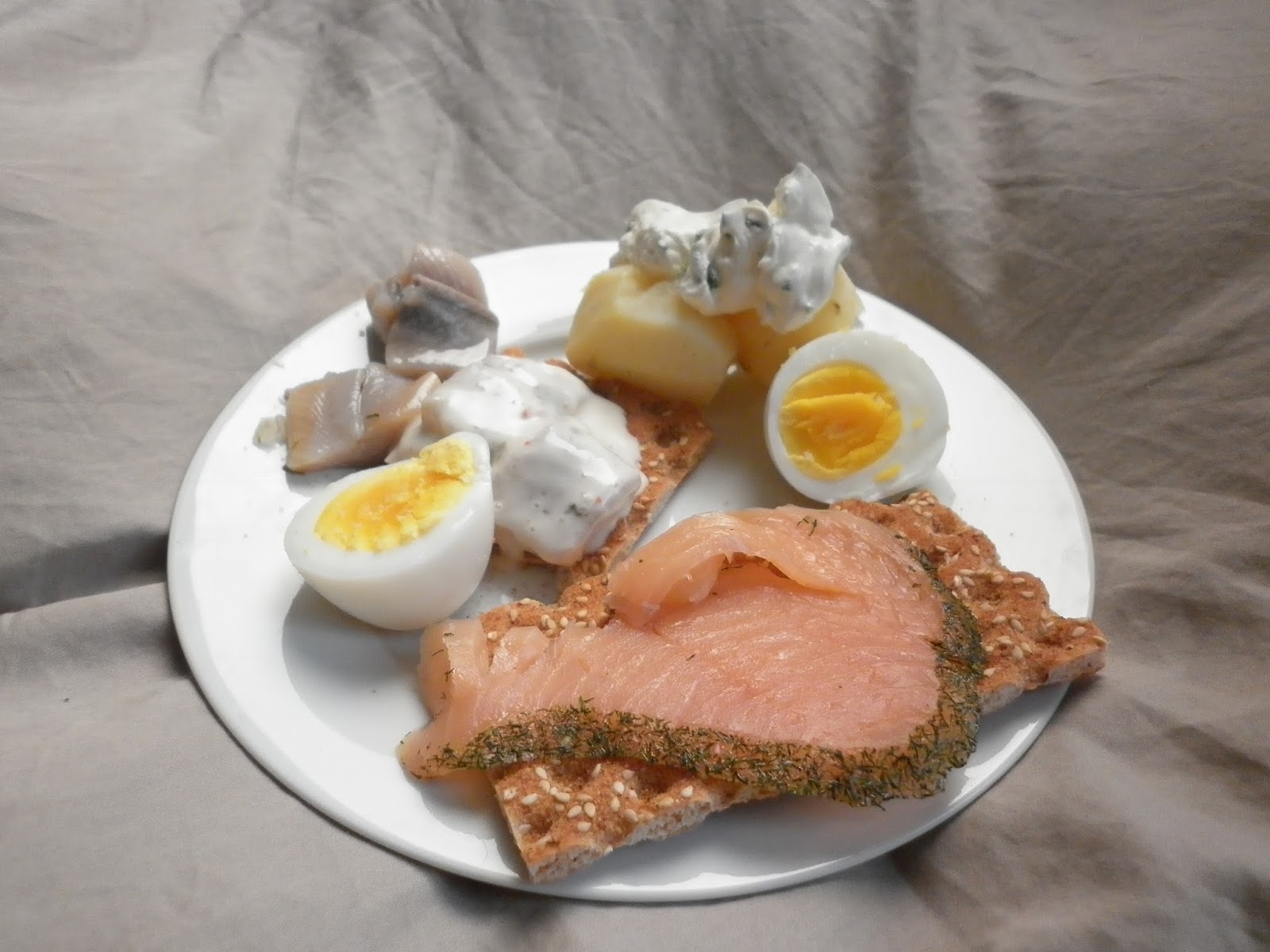
She describes the dinner we are having as a 'midsummer meal', which is traditionally served around the shortest night of the year. It consists of various elements: new potatoes cooked with dill (kokt dill potatis). The traditional topping makes it more luxurious: sour cream with chives ladled generously on top.
Then thick slices of cured salmon (gravad lax) and boiled eggs. Though I am not normally easily shocked, somehow it is mind boggling that the Swedish slice their boiled eggs in half differently from what I am used to. They slice them through the short side rather than the long side (see picture).

The smörgåsbord
The salmon, potatoes and eggs would already be a filling meal, but it is accompanied by a do-it-yourself buffet of knäckebröd with toppings. You can put different varieties of pickled herring on top, or 'Kalles kaviar' from a tube, or cheese, liver pâté, etc. All the music students swarm around the table like bees and dive in. Is it literally a smörgåsbord, a word I did not realize the origin of till now...it refers exactly this type of buffet with cold and warm dishes. I mainly had heard the expression used to mean 'a wide variety of choices', not per se referring to food.


Simone shaking up the cream
We discuss some of the stereotypes that exist about the Swedes. Apparently, they are known to be punctual. However, Simone teaches Swedish to a Dutch secretary at the Swedish embassy who says:"Pshah! Punctual!? Not really!" Everything is relative, of course...
There is also the idea that the Swedes, despite their economic good fortune, have much higher rates of depression, possibly due to getting less sunlight. Simone does not have the answers to why exactly, but will say she personally is happier outside of Sweden! The last couple of years, she has noted that Dutch people especially love stuff from her country. Design products, furniture, clothes (H&M or more upscale brands), even crime books. To be fair, not all Dutch make much distinction between Sweden and the other Scandinavian countries!
As a dessert, we are served fresh strawberries with cream, always a winner. There does not seem to
be a mixer or whisk on hand, so Simone just pops the cream in a tupperware (see pic) and gives it a good shake for a few minutes...with wonderful thick whipped cream as a result. Low tech sometimes works wonders!

Sunday, 26 April 2015

Meal 54. Danish Boller i Karry (Meatballs in curry sauce) with rice

Louise with guest Jason at the buffet table
 My last meal for the blog while in Sierra Leone is provided by the charming Louise, a friend of my previous host Sheka. I have not met her before I rock up at her home. It is filled with her children's drawings, but sadly, she has to miss their presence for now. Family life was disrupted by the Ebola outbreak in West-Africa, schools closed, and many ex-pats left temporarily. Thankfully, it looks like Louise will be reunited with her kids quite soon.
For the occasion, she has rounded up a few other compatriots that reside in Freetown. Nina has brought a tin of liver pâté (leverpostej), Susanne a jar of herring in curry sauce (karrysild) and Kim's contribution is desert; assorted licorice (vingummier, lakridser and piratos).

Salmon, liver pâté and avocados

After a little introductory round to get to know all the other guests, we cluster around the buffet table and help ourselves to the starters. Smoked salmon (a rare treat in Sierra Leone) with avocado and homemade cucumber pickles on bread. In Denmark, these open-faced sandwiches (smørrebrød) are quite a phenomenon, though they usually would use thin slices of dense rye bread rather than the French bread available to us here. What makes these sandwiches so special is the bread, the types of topping and the fact that huge amounts of the topping are heaped on the bread, be it
The meatballs in curry sauce
smoked salmon, cheese, or herring in curry sauce like today. I would not immediately associate 'curry sauce' with a Scandinavian country, but it appears to be an integral part of the Danish cuisine. Apart from the herring, the main course (chunky meatballs) is also served in curry sauce. They are not particularly photogenic, but I'm glad to report they are delicious. The sauce is not very spicy at all; it is seen as real comfort food, and great for kids too. The meatballs contain some vegetables as well (carrots) so with the rice it is quite a well balanced meal. Though all the Danes present confirm that potatoes are the traditional axis around which all meals revolve, they agree that this particular dish should definitely be served with rice. 'Exotic' elements like rice and curry already became integrated in Danish food many years ago, probably due to their colonial presence in India in the 17th-19th century.

Looks nondescript, tastes great!
However, Kim recounts that in the eighties some of his compatriots had never even tried products like avocado or papaya. He travelled to a small island and for an agricultural fair had prepared some for people to try. An enthusiastic visitor took a slice of papaya and immediately dipped it in the guacamole, yum!

After dinner we gather round the sofa and have some of the licorice. As I grew up in the Netherlands, I actually truly appreciate this as a treat. Some of the Brits present are less enthusiastic.

Somehow, I have convinced Susanne that the dinners for this blog always include the hosts singing the national anthem...and dutifully, the three blondes (Kim opts out) sit down and manage quite a few tuneful verses of (for me) unintelligible lyrics. They also explain some of the traditions surrounding Christmas and New Year Eve's celebrations, which involve the British comedy sketch Dinner for One being repeated on television year after year. And the queen's 
speech on December 31 is obligatory viewing for all Danes, not to be missed if at all possible.

A truly delightful evening. Afterwards Louise even sends me a picture of real Danish rye bread that she made herself a few days later (one of the guests at this dinner had brought the flour as a present). She uses a lot of exclamation marks to convey her excitement and writes that it was 'almost like Christmas'. Only when you are away from home for longer do staple foods take on such a special meaning!
So blonde, these Danes! All ready to sing the national anthem.